
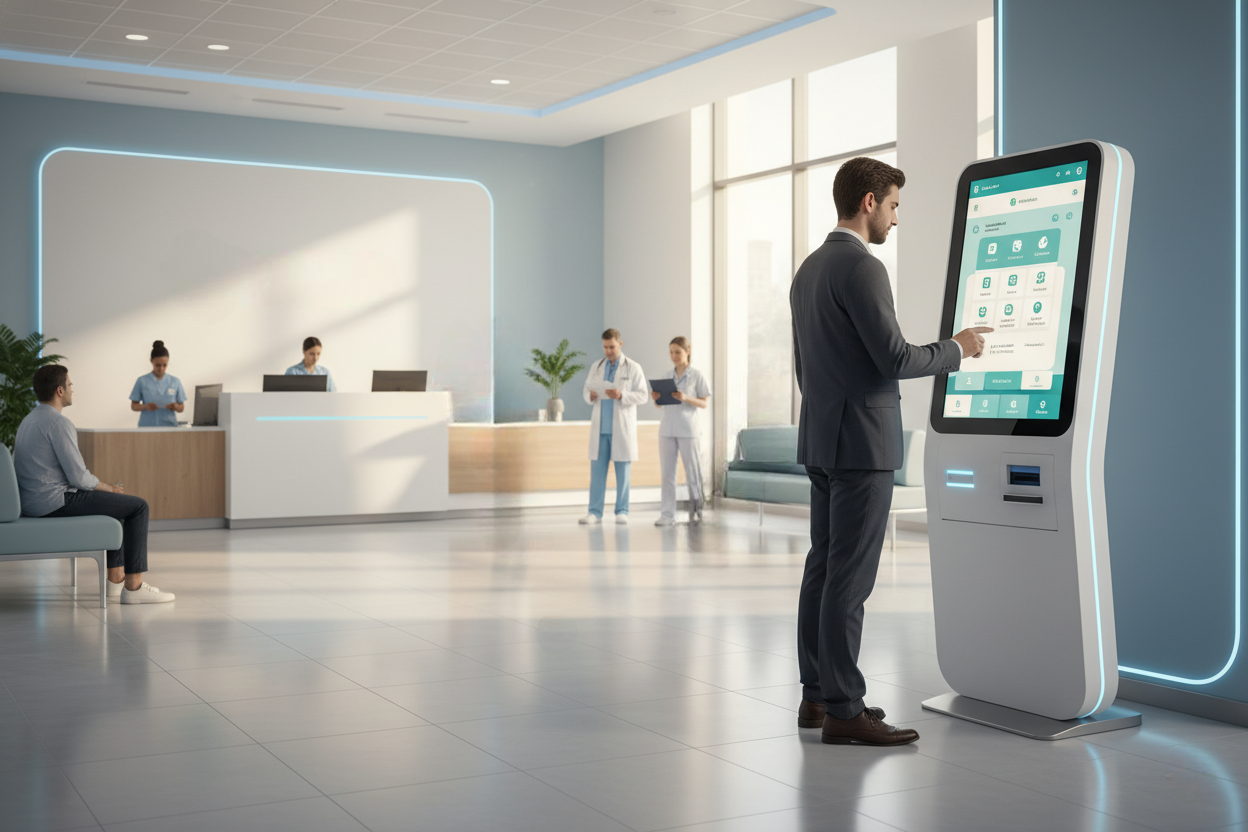
Why Hospitals in Saudi Arabia should deploy Patient check-in Kiosks?
You and I have been into that long lines in the hospital, right? Most probably, it could have been at the front desk as part of patient registration or at any department to claim your test report.
It’s quite an uncomfortable and annoying scenario to stand in a queue, while the only thing in your mind is to see the doctor or get things done at the earliest.
Long lines in the hospital premises, congestions, bottlenecks, can adversely affect the patient satisfaction scores. It not only affects patients, but puts a lot of burden on the hospital employees too, reducing the overall operational efficiency of your healthcare establishment.
Saudi Arabia – with its ambitious Vision 2030 initiative, is investing heavily in digital transformation, particularly in the healthcare domain.
Investing in a patient check-in kiosk and other smart hospital solutions can immensely improve the overall patient experience and hospital’s operational efficiency.
In this blog, we’ll take a closer look at these remarkable machines, their features and benefits in layman’s terms. Kindly, read through…
Saudi Vision 2030 - Implications on healthcare sector
Saudi Arabia is on its way towards the ambitious Vision 2030 initiative. The Vision is aimed towards the socio-economic transformation of Saudi Arabia, giving key importance to the healthcare sector.
According to Saudi Arabia Minster of Health, Mr. Fahad bin Abdurrahman Al-Jalajel “The Health sector transformation program prioritizes the well-being of Saudis through personalisation, digitalization and restructuring of the healthcare system.”
Some of the key objectives of the Vision 2030 Health sector Transformation program are listed below.
- Improve the citizen’s access to healthcare.
- Increased spending in healthcare sector though private sector participation.
- Enhanced healthcare efficiency through digitalization.
- Improve waiting times connected with service delivery in healthcare.
- Prioritizing disease prevention, improving healthcare facility, and acquiring quality workforce.
The SEHA Virtual Hospital is an integral aspect of the Health sector transformation program. This virtual hospital initiative provides virtual telehealth services through virtual consultation, and supports 130 hospitals in KSA. It offers specialized services like Emergency and Critical Consultations, specialized clinics, multi-disciplinary committees, Home Care, and Supportive medical services. The SEHA virtual hospital makes use of advanced technologies like Artificial Intelligence, Augmented Reality and Internet of Things for patient care and monitoring.
What is a patient check-in Kiosk?
A patient check-in kiosk is a self-service kiosk terminal that automates several patient-related services like patient check-ins, scheduling appointments, accessing patent information etc. As a result, the patient need not have to wait at the front-desk or interact with a hospital employee.
A patient kiosk terminal serves instrumental in improving the overall hospital efficiency and patient satisfaction.
The kiosk terminal is part of Panashi’s Smart Hospital solution, which we would cover later in this blog.
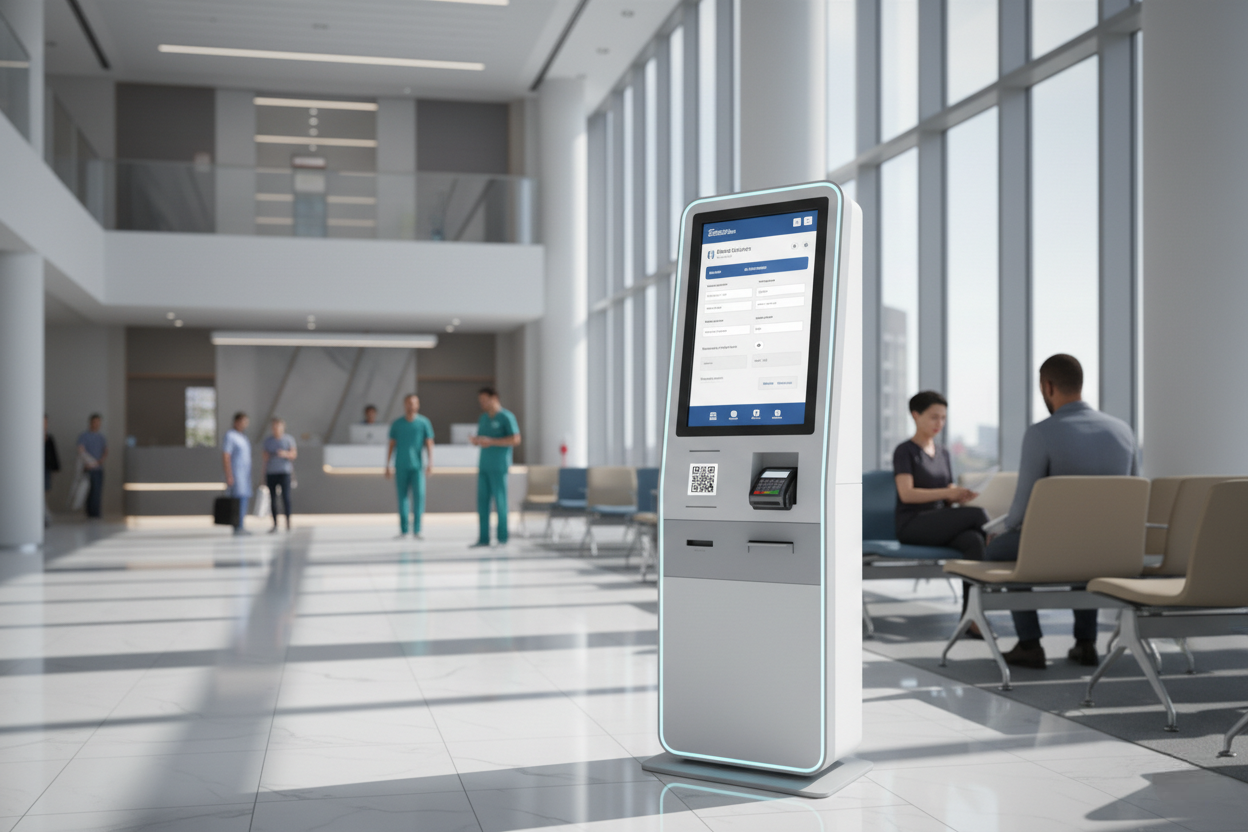
Key components of Patient Check-in Kiosk
The patient check-in kiosk is loaded with both hardware and software components to streamline patient check-in and results/certificate-retrieval tasks. And here they are:
Hardware components
- Intuitive touchscreen – The intuitive kiosk touchscreen facilitates effortless kiosk navigation, so that patients of all age-groups can access the machine with ease.
- Card reader/ Passport scanner – reads National ID card, Health cards or passports for patient authentication.
- QR code scanner – scans appointment confirmations.
- Printing device – prints medical certificates or test results upon patient request.
- Biometric scanner – makes use of fingerprint or iris scanning for patient authentication, thus improving the security and speed of patient check-in.
- Payment module – The patients can pay the consultation fees, or other payments via the kiosk payment module.
- Video conferencing module – the patient can engage in real-time video chat with a hospital executive for additional support or assistance.
Software components
- Patient-check-in interface application – the application guides patient in connection with check-in, appointment booking, payments, document retrieval etc.
- Multi-lingual support module – offers multiple language support like Arabic, English, Urdu etc. to cater to the multilinguistic society of Saudi Arabia.
- Hospital System Integration software – the software connects with the hospital database to retrieve patient records, update appointment information etc.
- Queue management software – Issues tokens to patients and directs them to appropriate departments.
- Insurance validation application – Instantly connects with hospital insurance database to check patient eligibility and co-pay information.
Features of a patient check-in kiosk terminal
Panashi self-service hospital kiosk terminals are feature-packed to streamline the operations of hospitals, clinics and other healthcare providers. The features are listed below.
- Automated patient check-in –Patients can easily check-in via the kiosk terminal by entering the National ID or Iqama or QR code.
- Multiple payment modes – the doctor consultation fee can be paid via multiple payment modes like cash/card/ cardless or via mobile app.
- Multi-language facility – the patients can choose their preferred language from a list of languages for the purpose of kiosk navigation.
- Print medical history – patient can easily print medical history based on various categories like inpatient, outpatient, number of months, emergency etc.
- Access test results – Access categorized test results by period, function, pathology etc. with a few taps on the screen.
What are the Benefits of a Patient Check-in kiosk machine?
Hospital benefits
Here are the major benefits of a Hospital check-in kiosk in a hospital perspective.
- Faster and efficient patient flow – Automated patient check-in via the kiosk machine improves patient flow, reducing bottlenecks and congestion.
- Improved operational efficiency – The hospital kiosks automate the patient check-in process, thus reducing the administrative burden on the hospital staff. The faster the check-in process, shorter the queue, and better the patient throughput. This diminishes the chances of congestion inside the hospital, enabling smooth patient flow.
Moreover, the hospital kiosks are connected to the Hospital Information system (HIS), Electronic Medical Records, and Queue Management System. It helps hospitals acquire real-time data updates easily, and facilitates efficient patient management. This interconnectivity of the patient check-in kiosk with various hospital systems significantly improves the hospital’s operational efficiency.
- Remote monitoring – A remote admin can monitor the patient check-in kiosk from a central location and deploy software updates, patches, whenever it is needed. The remote monitoring facility helps the admin to monitor the day-to-day performance of the kiosk machine.
- Reduced administrative expenses – The kiosk machine handles the front-desk responsibilities with utmost efficiency, so that your front-desk staff are freed-up for more productive or patient-centric tasks.
- Customizable – Panashi Hospital kiosk solutions are highly customizable to suit various departments or requirements like general patient check-in, pharmacy self-service, Information Access etc. Even the kiosk enclosure design, UI, color can be customized to meet the branding of your healthcare establishment.
- Scalable solution – Panashi patient check-in kiosk machines are perfectly scalable to meet your future expansion needs.
Patient benefits
Your patients too can experience the benefits of Hospital kiosk automation.
- Faster patient registration/ appointment conformation – Conventional hospital receptions request the patient to fill a form with necessary information, and then feed the information into the hospital system. The hospital kiosk eliminates the time-consuming form-filling and the front-desk data entry procedures. The patients may simply scan their National ID and register the information directly at the kiosk.
Similalry, the appointment confirmation can be done, in a matter of few seconds. Once the patient performs patient identification with a National ID card/ OTP/ QR code or biometric verification, the kiosk instantly displays the upcoming appointments. And, appointment details have the options to confirm, modify or even cancel the appointment. See, how convenient the processes are!
- Reduced patient wait time – Patient check-in kiosk machines reduce human touchpoints. Patients need not interact with the front-desk staff for patient registration or appointment confirmation, thus reducing the wait time. A patient check-in kiosk is estimated to reduce wait time by up to 70%, studies claim.
- 24/7 patient access – If deployed at hospital entrances or other accessible areas, patients can access the kiosk machine at their convenient time, 24/7. They can easily print test reports, and medical certificates at their comfort, by entering the patient credentials.
- Accessibility-friendly kiosk design – Panashi Hospital kiosk machines are loaded with accessibility features like screen magnification software, tactile keypads, braille keyboards, speech-to-text and text-to-speech features, audio jack facility etc. All these features are of great assistance to the physically challenged patients.
For additional reading on Accessibility features on self-service kiosks, please visit our blog here.
- Improved patient experience – The reduced wait time, faster check-in process, multilingual support, real-time video chat assistance, accessibility-friendly features – all contribute towards improved patient experience.
Panashi Smart Hospital System
Panashi Smart Hospital system is a comprehensive solution designed for hospitals and other healthcare establishments to streamline administrational responsibilities and day-to-day operations. The comprehensive hospital solution also helps healthcare providers offer exceptional patient care and increase profitability. The solutions comprise of the following.
Bedside station terminal – The bedside patient terminal is an in-patient facility. The patients can make use of the same to access information, and it serves as an entertainment platform with TV and radio facilities. The facility helps patients to easily communicate with their medical care team, family members, and even order meals whenever they feel like. This brings in a personalized experience to the patients, helping in patient retention.
Patient check-in Kiosk – I’ve already covered the major aspects about patient check-in kiosk above.
Hospital mobile application – The patients can make use of the hospital mobile app to access a plethora of services like finding doctor, booking appointments, making payments via card/bank transfer/mobile app etc. The mobile app supports patient authentication through OTP/ patient ID. The hospitals can push notification and alerts to inform patients about scheduled appointments, generate tokens etc.
Indoor navigation facility – The Indoor navigation facility offers route guidance and indoor navigation facility to the patients so that they can easily navigate the hospital premises without external intervention. It facilitates navigation between buildings, floor-to floor, same floor etc.
Asset tracking system – monitors hospital assets like infrastructure, equipment, medical supplies, and many others which includes medical practitioners and hospital staff. This is possible by leveraging advanced technologies like RFID, IoT, and sensors. RFID monitor various physical parameters like humidity, temperature etc. and gives valuable information about resource utilization. RFID-enabled wristbands help to monitor the current location of the employees. This helps hospitals locate their precise location in the hospital premises, and assign tasks, based on priority, at the earliest.
For additional reading on Panashi’s Smart Hospital Solutions, please visit our official page here.
Conclusion
The current population of Saudi Arabia is estimated to be around 35 million. By 2030, the population is projected to go beyond 40 million. Hence, the Kingdom’s healthcare requirements are bound to increase in the coming years. This means that the population rise clubbed with economic diversification strategies would seriously test the healthcare resources of the Kingdom, in the coming years.
Investing in a patient check-in kiosk at your hospital’s front desk or at any other high-traffic location can be a feasible option to manage patient flow. These, self-service healthcare kiosk terminals speed up patient check-in process, and also helps patients gather medical certificates and test reports within seconds.