
Self-checkout Kiosk Challenges and Ways to Overcome (2026)
In the ever-evolving domain of retail technology, not many innovations have sparked as much debate as self-checkout kiosks. These checkout machines were introduced with so much of rewarding benefits like improved operational efficiency, reduced labor cost, enhanced CX and much more! And they have become extremely common in the retail sector, especially in supermarket chains around the globe.
Even after two decades after their introduction, the pressing question still remains!
Have self-service checkout kiosks become a failure? Have they failed to deliver those promises?
I cannot give you a straightforward, simple answer. You would definitely know why is it so after reading the blog. Stay tuned…
The rise of self-checkout technology
It all started in the American supermarkets in the 1980s, but gained significant traction and popularity in the early 2000s. The deal was lucrative, in the sense, the customers can scan, bag and even make payment for the purchase items independently, without any human intervention. To add on, the self-service checkouts reduced waiting times, and facilitated improved employee allocation for supermarkets and retailers. A fantastic deal for both the customers and the businesses, isn’t it?
The first self-checkout system was developed by a company named “CheckRobot” and was implemented in the US-based Kroger grocery stores, in the mid-1980s. Thereafter, several renowned retailers like Walmart invested in the technology.
The pandemic times witnessed a surge in adoption of self-checkout technology. The technology facilitated a contactless shopping experience, which was quite like a norm than a convenience in the pandemic-affected times.
According to the data revealed by Fortune Business Insights, in 2023, the self-checkout market size was valued at 4.88 billion US dollars. The value is projected to reach 17.8 billion US dollars, by 2032, achieving a CAGR value of 15.5%.
What are the benefits of self-checkout kiosks?
Self-checkout kiosks bring a host of benefits that make shopping faster, easier, and more convenient for everyone. Or, in other words, these are the benefits promised by self-checkout machines. In reality, do they satisfy all these claims, is something debatable.
- Faster checkouts – with sufficient number of self-checkout machines in place, sell-checkout kiosks facilitate simultaneous checkout of customers.
- Reduced waiting time – Faster checkouts reduce customer waiting time.
- Improved customer satisfaction – faster checkouts and reduced waiting time improve customer satisfaction.
- Improved employee allocation – self-checkout machines eliminate the conventional cashier-initiated checkout interactions, and therefore, helps in improved employee allocation. The existing or freed up employees can be reassigned to other vital tasks like customer service.
- Improved CX - Customers get more control over their shopping journey.
- Flexible payment options – Self-checkout machines offer multiple payment modes like cash, card, cardless or mobile app, which adds much convenience to the customers.
- Customer insights – the retail businesses get valuable insights and data pertaining to their customers regarding peak times, customer behavior, etc. The data can be used to improve or tweak existing services.
- Scalable solutions – Self-checkout kiosk machines are easily scalable, if situation demands. Whether it’s to meet seasonal spikes in demand, festival occasions or maybe future expansion plans, retailers can easily scale the self-checkout machines.
What are the downsides or drawbacks of self-checkout kiosks for retailers?
Even though checkouts kiosks have a lot of benefits, they do come with certain challenges. And those challenges are serious enough to rethink the feasibility of these self-service machines. And here are they.
1) Retail shrinkage and self-checkouts
So, what is retail shrinkage?
Retail shrinkage or sometimes denoted as simply shrink is simply the unaccounted loss on inventory.
Multiple factors contribute towards shrinkage like theft, administrative errors, vendor frauds, spoilage etc. Of course, it’s a larger issue.
Right now, let’s deal with shrinkage linked to self-checkout kiosks.
Self-checkout machines can attract theft into the retail scene. Let’s analyse some of the common scenarios.
- Intentional theft – Some customers are so “determined” that they intentionally do not scan all items, and walk out without paying for all the purchased items.
The psychology is pretty straightforward. When there’s no human watching you scan each item, that moral barrier gets a little lower. “I forgot to scan that” becomes an easy excuse, even to yourself.
The shrink rate due to self-checkout kiosks is estimated in between 3.5% and 4%, whereas shrink rate linked to cashier checkouts is less than 1%. And, the disparity is clear.
Noted something interesting from DeAngelis Review website regarding self-checkouts, and here it is. – “Self-checkout turns customers into employees and employees into security guards.”
Do you agree, folks?
- Unintentional errors – users may go wrong, at times, and it is completely understandable. They might accidentally skip items, or make barcode scanning errors.
2) Reduced human intervention
It depends on customer preferences. Older customers who visit groceries may prefer human contact points instead of no-human, self-checkout solutions. Some customers are accustomed to having brief chats and interactions with cashiers and supervisors while they are on the checkout lanes. This lack of human contact points can affect the overall customer experience of a certain cross section of retail customers.
3) Technology errors
Anyone with a considerable experience handling self-checkout kiosk machines might have come across alerts like “unexpected item in bagging area”. They might even have faced difficulties while scanning produce items without barcodes. Theses issues confuse users and increase the wait times.
4) Checking out non-standard items
Certain items with irregularities in shape, barcode errors or damages, or the ones that carry age-related restrictions, can result in checkout errors and delays, costing the time of customers. These scenarios are not common; however, they do exist.
According to a New York Times survey conducted in 2015, the use of self-checkout lanes corresponds to 46% rise in retail shrinkage, when compared to traditional checkout lanes. It’s billions of dollars lost in the form retail shrinkage.
In a global survey conducted by ECR Retail Loss, around two-third of the survey participants have identified that self-checkouts contribute towards retail losses. And, they also admit that the issue has become a matter of concern.
How retailers can overcome self-checkout kiosk challenges?
With consistent efforts, innovation and technology integration, I think, retailers can steer clear through the self -checkout challenges. And, here are the ways.
Limit number of items per transaction – Now, this is more of a commonsense. By limiting the number of items per transactions, you are reducing the chances of someone thinking out-of-the-box, yes, I mean it – intentional theft. Retailers can implement this as a shrinkage prevention strategy for high-risk stores. And you may even encourage large cart customers to make use of supervised lanes, which gives out the message to the customers that “they are monitored”.
AI camera and weight sensors – Retailers can integrate AI camera and weight sensors into the checkout system to detect frauds, suspicious activities and scanning errors.
AI camera is usually mounted above the self-checkout kiosk machine, and it continuously monitors the customer checkout process. The Computer Vision-powered AI camera monitors various checkout-related aspects like the physical characteristics of the purchased items, hand movements, post scanning events, etc. to detect fraudulent activities like scan-skipping, barcode switching, etc.
The weight sensors are used to check the weight of the scanned item. The POS system checks the weight of the scanned item against the actual weight of the item as stored in the inventory database, hence comparing the two. Any discrepancy in weights, get flagged immediately.
The AI camera and weight sensor data are linked to the POS software real-time. Hence, in case of any discrepancies in either of the data, the system produces the necessary alerts, and calls for human intervention.
Scan-and-Go – Mobile Scan-and-go presents another innovative retail checkout strategy that allows customers to scan items, and pay for the same through dedicated mobile apps. Walmart has successfully implemented the Mobile Scan-and-go technology that streamlines the in-store shopping experience for customers. Right now, the Scan-and-go feature is available exclusively to Walmart+ members which involves subscription.
Here is how to perform Mobile Scan-and-go through Walmart stores.
- Visit the Walmart store.
- Open the Walmart app, makes sure you’ve enabled location access for the app.
- Scan your items as you shop and when done verify the selected items.
- Tap the Checkout button and proceed towards payment.
See, how easy and convenient the entire process is!
AI and Computer Vison technology for self-checkouts – Computer Vision is the technology that empowers computers to derive useful information from various visual cues like photos, images of objects, videos etc. In short, the technology enables computers to observe and understand and arrive at various conclusions.
For example; the technology can instantly identify the items you purchase from a grocery store, and come up with their total price in few seconds. The technology, powered by AI, is still on the emerging phase.
Computer Vision technology avoids the problem of user-initiated barcode scanning in self-checkout lanes. User-initiated barcode scanning takes considerable amount of time as users are no experts at barcoding purchased items.
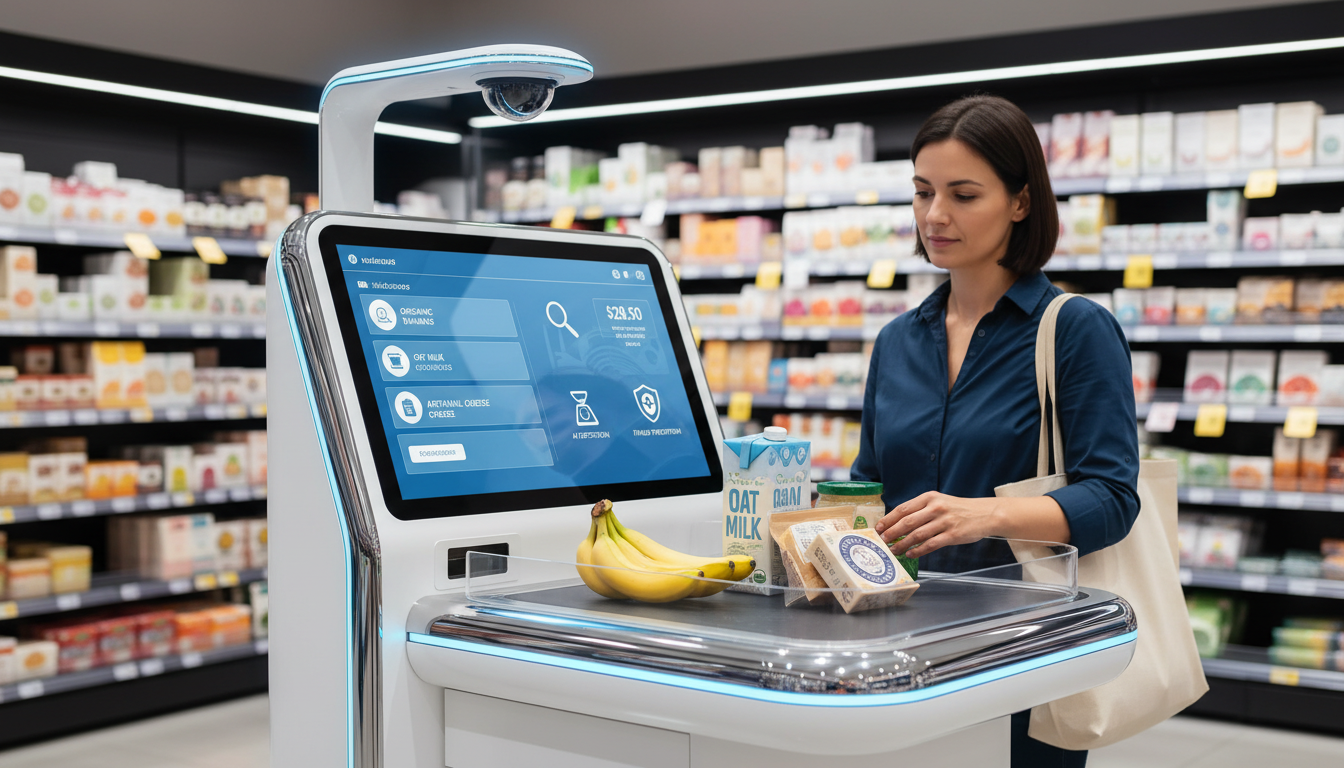
In case of Computer Vision-aided checkouts, the user only needs to place the purchased items on the kiosk tray, and the rest is done by the system. The items are identified in a split-second, and the itemized bill amount is displayed on the screen. The user can make the payment and leave instantly with the purchased items.
Mashgin is a leading provider of computer vision-enabled checkout solutions and their solutions are highly reliable and consistent in item identification. The faster and convenient checkouts have significantly helped to improve Customer Experience, reduce labour costs, and improve revenue of Mashgin’s clients. Check out Mashgin’s AI-powered self-checkout solutions and case studies here.
Conclusion
Self-checkout kiosks can be simultaneously convenient and at the same time, a bit annoying for the customers, at certain occasions. It’s cost-saving when it comes to improved employee allocation, but prone to theft which is waste of money and resources. Yes, there are certain pros and cons. And the cons cannot be overlooked.
As retailers continue refining these systems—or replacing them with even more automated and sophisticated solutions—I hope they remember that technology should serve people, not the other way around. Technologies like Amazon’s Just walk Out has the potential to fully transform the retail scene. Who knows, one day, we wouldn’t be visiting a physical store to purchase grocery items, but might very well purchasing the same through Virtual Reality!
So, let’s hope for the best.