
Why McDonald’s AI Drive-Thru with IBM Failed
Even with IBM’s collaboration, the much-awaited McDonald’s voice-assisted AI-drive thru became a failure. The failure resulted in McDonald withdrawing the technology from more than 100 drive-thru outlets.
However, McDonalds has not come up with an official statement citing the reasons for failure, one of the prime reasons for the rollbacks point towards the inaccuracy connected with automated order-taking.
In this blog, we’ll discuss the reasons for the failure of McDonald’s AI drive-thru, the AI voice-over technology and its scope in drive thru settings, and the lessons to learn from the failed project.
Now let’s dive in…
Certain quick facts on McDonald’s
- McDonald’s is one of the most prominent players in the QSR domain.
- It was established in 1948 by Richard James and Maurice James McDonalds.
- McDonald’s is the world’s No.1 revenue-generating restaurant chain in the world.
- As per Statista, in 2023, the net income of McDonald’s was estimated to be $8.47 billion.
- The restaurant brand is operational in more than 37,000 locations, spread across more than 100 countries.
- As per 2023, McDonald’s was the most valuable QSR brand, globally, with a brand value of around $191 billion.
- The fast-food giant’s revenue generation model is through franchising.
- McDonald’s serves around 68 million customers, globally.
- The major competitors of McDonald’s are KFC, Burger King, Wendy’s and Subway.
Developments that led to collaboration with IBM
Apprente acquisition – The precursor of the collaboration with IBM was the acquisition of the start-up named Apprente, in 2019. Apprente, back then was renowned for its voice-assisted AI technology with advanced speech recognition and NLP systems. McDonald’s wanted to integrate this advanced technology into their drive-thrus to improve the overall food-ordering experience. The acquisition was followed by initial testing in certain drive-thru locations. This testing became crucial in determining the actual obstacles involved in real-life drive-thru scenarios.
Partnership with IBM – McDonald’s declared its collaboration initiatives with IBM in the latter half of 2021. The strategic alliance was initiated to further enhance its AI drive-thru initiatives by leveraging IBM’s advanced technology know-how and cloud computing capabilities. With IBMS’s technological support, McDonald’s had plans to expand their voice-over technology integration to a greater number of drive-thru outlets.
Technology involved in McDonald’s AI drive-thru
McDonald’s is always at the forefront of adopting innovative strategies to improve their operational efficiency and CX. They do their best to learn the preferences of their target customers. The implementation of self-ordering kiosk to streamline food-ordering, mobile app integrations, drive-thru restaurant facilities, the use of AI tools for personalised menu suggestions, the implementation of smart kitchens to streamline cooking, and the list goes on…
McDonald’s AI drive-thru transition involves 4 key aspects and they are listed below.
- Natural Language Processing (NLP) – NLP is a sub-division of AI that helps computers decipher human languages. NLP was an integral aspect of the voice-over technology. Understanding human language is a complex process as it involves several variations like regional accents, dialects and slangs.
- Speech recognition – The spoken words used at the time of food-ordering have to be converted into text format. This process is carried out by the speech recognition system. The system removed unwanted background noises to ensure clarity and order accuracy.
- Machine Learning (ML) – Machine learning is all about continuous learning. Every customer interaction is a learning process. With time, Machine learning algorithms refine and tweak the ordering process, and eliminate errors and other inconsistencies.
Leveraging cloud data – With IBM cloud support, the system could handle extensive data and process the same in minimum time. This enabled efficient, real-time data processing.
The scope and benefits of AI voice-over technology in QSR settings
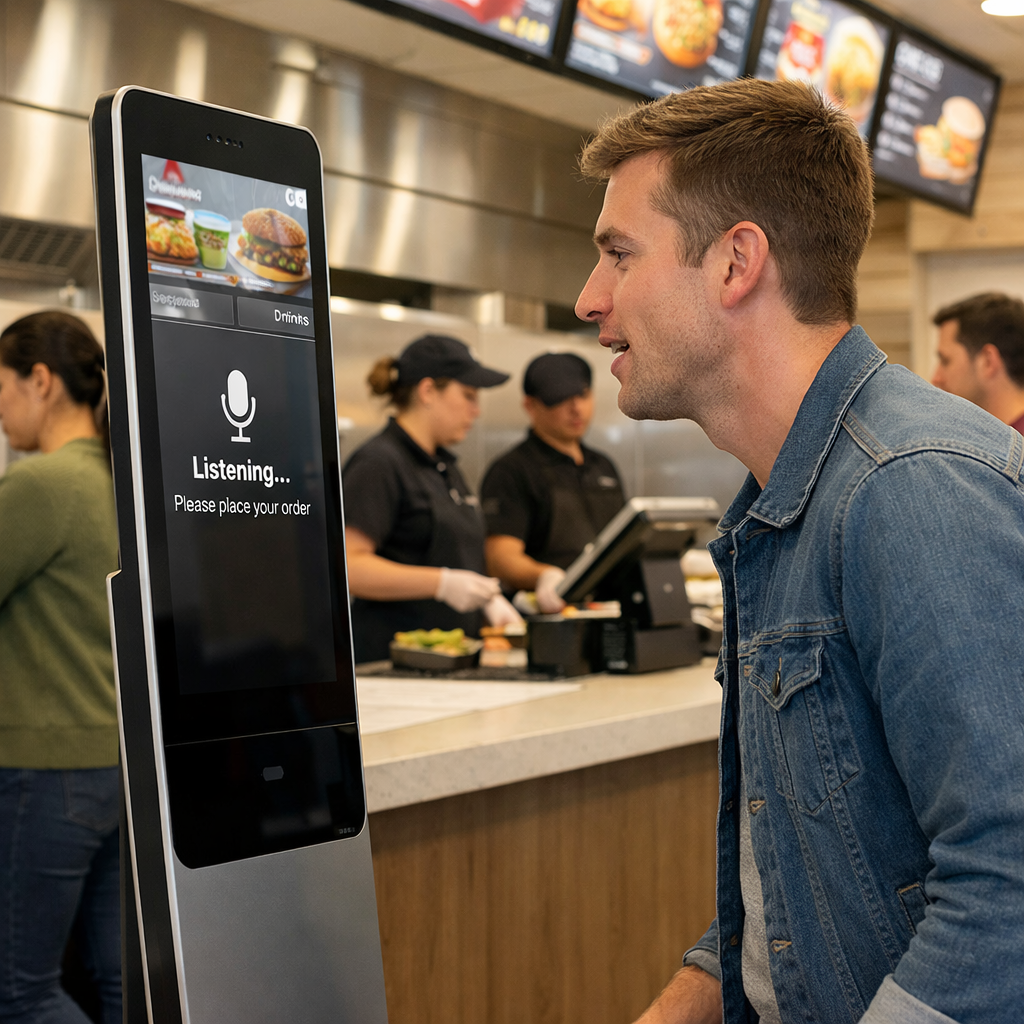
The greatest benefit of AI voice-over technology in QSR settings is the ease of ordering.
- Voice-assisted ordering – the customers can make voice orders in busy drive-thrus which makes the overall ordering process highly convenient.
- Improved order speed – Voice-orders facilitate fast and smooth food-ordering which reduces waiting time.
- Contactless interaction – the technology eliminates physical kiosk interactions, thereby facilitating contactless ordering experience.
- Accessibility benefits – People of determination can easily access the kiosk machine and easily makes their orders. For example: if a customer has some sort of visual impairment, the person can easily make voice orders via the kiosk machine, in a matter of few minutes. Accessibility-friendly features give out the message that your business values diversity and inclusivity. Recent studies state that the young adults, particularly the Gen Z population, appreciate diversity and inclusivity in business settings.
- Voice-assisted payments – Voice biometrics authentication helps customers perform voice-assisted order payments bypassing touchscreen interactions. Voice-assisted payment facility reduces the kiosk interaction time and thus eliminates the long lines.
- Personalized interactions – based on voice biometric authentication, the kiosk system can recognize individual customer and offer personalized deals and special offers based on customer preferences.
- Improved hygiene – Voice-assisted kiosk interactions drastically reduce physical interactions at the kiosk interface, thereby ensuring hygiene. In the post-pandemic era, customers are highly aware of the implications of touch-induced contaminations.
- Voice-over customer feedback – The technology helps customers provide voice-assisted feedbacks. They need not use a keyboard or rely on the kiosk touchscreen for the sake of sending feedbacks. To add on, customers can send genuine feedbacks in seconds which adds to the convenience. Customer feedbacks are vital to understand customers sentiments, and make necessary adjustments and tweaks in the services.
- 24/7 operations – with voice-over AI, businesses can operate 24/7, day in and out.
- Improved Customer Experience – Customers can make their voice orders on the go, and even make voice-assisted payments in drive-thrus. This reduces interaction time and offers a much smoother and convenient food-ordering experience.
Reasons that led to the failure
McDonalds integrated AI in their drive-thrus with an intention to improve the overall food-ordering experience for the customers, in the perspective of convenience. However, McDonald’s customers were reluctant to give a warm welcome to the technology integration. And the reasons are furnished below.
- Order inconsistencies – the AI system made significant errors in understanding or analyzing the customer orders which resulted in order errors. For some reasons, the system could not recognize certain basic orders, and in some occasions, asked the customers to reconfirm the order repetitively. What made things worse was that the customers recorded these errors and uploaded them on various social media websites like YouTube, which caused much embarrassment for the brand.
- Accent errors – the system failed to process accent-related variations, and intricate orders. And even background noises affected the system responses. Customers did not appreciate these mismatches as well.
- Frustrated, dissatisfied customers – order misinterpretations even after repeat trials led to an increase in customer interaction time and hence the wait time. The order errors clubbed with increased wait times resulted in widespread customer dissatisfaction.
Challenges in technology implementation in general
AI voice-over technology has significant potential in enhancing customer experiences in fast foods and QSR environments. However, there are certain key challenges too.
- Data privacy – The customer voice data is sensitive and is prone to hacking or theft. Therefore, businesses should take all the necessary measures to protect the sensitive customer data at all costs.
- Unwanted background noises – Eliminating background noises in busy drive-thus is not at all an easy task. Vehicle noises, people conversations, etc. are common in drive-thrus. The background noise may interfere with the customer’s voice orders and may result in order misinterpretations. Therefore, removing the background noise is crucial and its challenging too.
- Technology implementation expense – As of now, the technology implementation part can be a costly affair for small restaurants. For the same reasons, only fast-food giants like McDonalds, Wendy’s and other hospitality leaders invest in the technology.
McDonald’s AI-drive thru Failure – key lessons
If you are a service provider or even a technology solutions provider, there are several lessons to learn from the McDonald’s failure. The key takeaways are:
- Rigorous testing in real-world scenarios – The way customers interact with a self-ordering kiosk machine in a QSR differ, and these differences and variations are highly intricate too. For example: A customer might take a particular approach to order something very basic, the same customer may take a different approach for complex orders, simply for no reasons. Hence, the AI should undergo testing in real-world conditions to accommodate real-life variations.
- Integrating user feedback loops – Integrating user feedback loops helps to make the necessary changes in the AI systems based on real-world customer interactions and feedbacks. This improves the adaptability of the AI system to varying user inputs or needs.
- Training data – Now, the AI’s output is indicative of the nature and the variety of the training data. If the training data has several variations and is of superior quality, it can immensely help with the performance of AI. The training data should contain adequate variation of accents and dialects, and even background interferences to match an actual, everyday drive-thru setting.
The training data should be updated consistently so that the AI makes room for accent or other linguistic changes and nuances.
The scope of AI voice-over in other industries
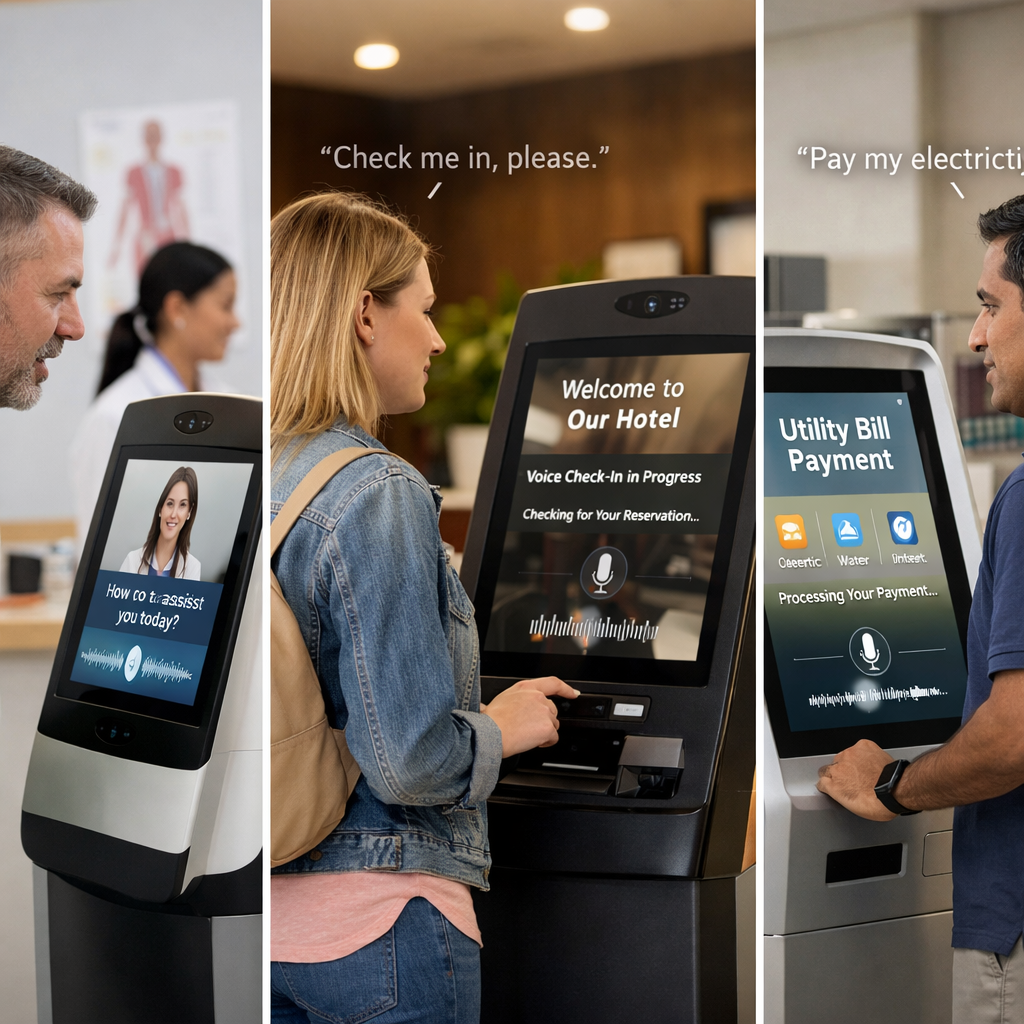
Voice over AI has immense potential in revitalizing customer service in not just the QSR domain, but in other sectors too like healthcare, hospitality, entertainment, and utility bill payment.
- Ai voice-over in healthcare – AI voice-over technology opens up a whole lot of possibilities in the healthcare sector particularly in connection with patient management and care. Healthcare facilities can make use of the technology for remote medical consultation. Moreover, the technology can become instrumental in assisting patients with visual impairments and other accessibility-related issues.
- Hospitality industry – the technology can streamline some of the core tasks in Hospitality industry like facilitating a voice-over room service and assistance system, the implementation of voice-enabled check-in kiosks, managing smart devices in rooms etc.
- Entertainment industry – Now, watch out for the developments in the entertainment industry! AI voice-over technology has the potential to transform the entertainment industry by providing voice-over assistance for a wide range of entertainment-related contents like movies, games, live-streaming videos, events etc.
- Utility bill payment – How about interacting with an AI chatbot to pay your utility bills? The technology assists users through bill payment, send notifications related to payments to users, provide customer service etc.
The Final wrap up
Even though, McDonald’s AI-drive thru initiative experienced a serious challenge, the technology is here to stay, improve and evolve in the coming years. Even though Mc Donald’s ended up collaboration with IBM, the fast-food giant would continue with its AI drive-thru initiatives, in the near future. Both the McDonald’s and IBM are working with their partners on the technology. So, there is hope!
AI voice-over technology improves customer service by providing faster, more efficient and personalized interactions. AI’s ability to adapt to customer needs, perform large-volume tasks, and handle 24/7, uninterrupted operations make it highly suitable for the service sector.
McDonald’s – I’m waiting, fingers-crossed for your next move or intervention in AI drive-thru. And I wish all the very best.