
The Future of Currency Exchange Kiosks in Saudi Arabia
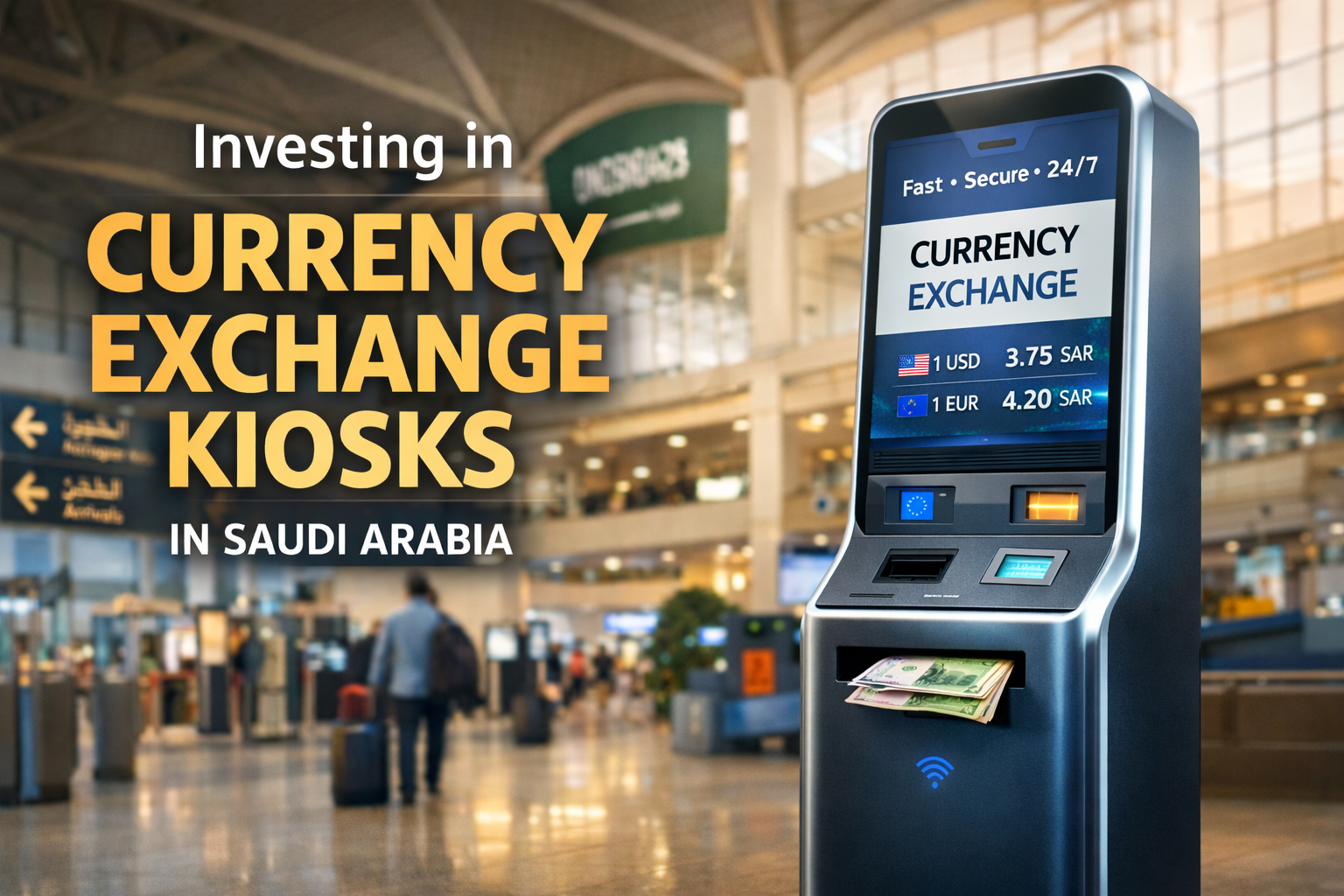
Saudi Arabia’s gearing up for something big with its Vision 2030 plan. Yes, a massive push to modernize and shake things up. And with all that change, people are craving financial services that are quick, smart and tech-savvy. Enter the currency exchange kiosk. Picture a sleek, self-service machine that makes swapping money as easy as grabbing a coffee. These little powerhouses are popping up all over the world, and they could be a goldmine for Saudi Arabia—a perfect mix of convenience, safety, and room to grow.
So, why’s Saudi Arabia the perfect spot for these kiosks? What’s in it for the folks using them—and the ones investing? This blog lets you know about the same. Stay tuned…
Saudi Arabia Foreign exchange market
According to the research conducted by the IMAR Group, in 2024, the Saudi foreign exchange market size was 6.2 billion US dollars. And the value is projected to reach 10.2 billion US dollars, in 2033, achieving a growth rate of CAGR 5.3%.
Here are some of the chief factors driving Saudi Arabia’s foreign exchange market.
- Saudi Arabia’s Vision 2030 and economic diversification initiative
- Tourism boom
- Religious tourism connected with Hajj and Umrah
- Rising population of expats
- Expanding trading partnerships with Asia, Europe and Africa.
- Growth in fintech and digital transformation
- Rise in Infrastructure and Transportation projects like NEOM and Red sea projects.
How does a Currency exchange kiosk work?
The way a typical currency exchange kiosk works – I have explained the process with the help of a story, to make it more interesting. And the story revolves around Abdullah and his experience with a money exchange kiosk machine.
And here is how the story goes.
Abdullah is a traveller from Saudi Arabia and he is on a middle-east tour. And he did have an interesting experience with a currency exchange kiosk machine during his travel. Here is Abdullah’s story in brief.
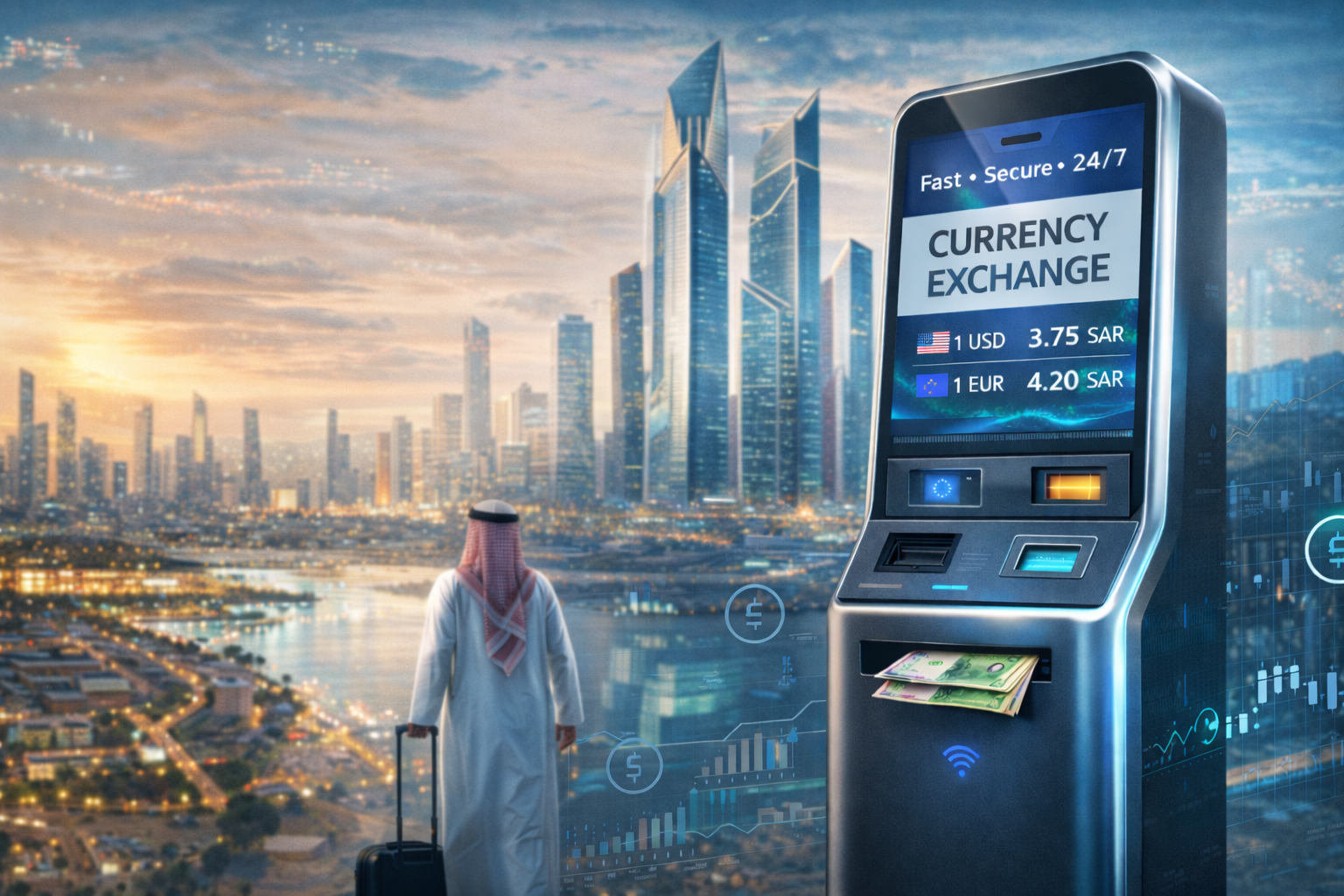
Enjoying the lively atmosphere of Riyadh’s King Khalid International Airport, Abdullah stepped off his flight from Istanbul, with a feeling of excitement. After a long journey, he was finally back in Saudi Arabia. And his immediate priority was to get some riyals. He spotted a modern self-service kiosk near the arrival gate. And, its glowing screen boldly displayed “Currency Exchange, Fast, Safe and Self-Service.” Amjad approached the kiosk and tapped the screen which displayed instructions in both Arabic and English. He selected “English” and easily navigated through the prompts.
Abdullah slid his euros into the note acceptor, genuinely impressed by how quickly the machine counted and showed him the conversion rate. In a fraction of seconds, the kiosk presented him with the best rate available, and after his approval, crisp Saudi riyal notes came rolling out of the dispenser. A clear breakdown of service charges popped up, making everything easy to grasp.
What really caught Abdullah’s attention was how smooth the whole process was. No waiting in line or no forms to fill out. And, even no awkward chats with any counter staff about exchange rates.
Beside the receipt printer, Abdullah spotted a small scanner that let users scan their ID or passport for larger transactions. Of course, an extra layer of support! He couldn’t help but admire how efficient the system was designed to serve both tourists and returning residents like himself. As he inserted the cash and receipt into his pocket, Abdullah couldn’t help but smile.
This wasn’t just a machine; it was a whole new level of convenience. As he rolled his luggage toward the taxi stand, he reflected on how much time he’d saved during the transaction process. Abdullah also realized that how currency exchange, which used to be such a hassle, had turned into a quick and easy task. The kiosk stood quietly behind him, ready for the next traveller in need of a fast, secure exchange.
Abdullah’s money exchange kiosk experience is an example of how technology is reshaping everyday tasks all over Saudi Arabia and the Middle-east.
Features of a Currency Exchange Kiosk
A money exchange kiosk is equipped with necessary hardware and software components to streamline money exchange functions. And, here are they.
Hardware components
- Touchscreen display – the intuitive touchscreen display facilitates easy kiosk navigation.
- Currency acceptor and dispenser – A currency acceptor accepts various foreign currency denominations, while dispenser dispenses the exchanged currency.
- Coin acceptor and dispenser – Accepts and dispenses coins for small value transactions and balance disbursement.
- Receipt printer – prints receipts of money exchange transactions.
- POS machine for card payment – Allows credit/debit card transactions.
- Barcode/ QR code scanner – scans various documents for user identification like KYC.
- Camera and biometric scanner – capture facial biometric features of the user for added security.
- Passport scanner – scans the passport of the user.
- Video calling facility – initiates video calling with the user and backend agent to sort out foreign exchange-related clarifications.
Software components
- User interface application – the application streamlines kiosk navigation and helps users select the desired currency, offer real-time exchange rates etc.
- Currency exchange engine – perform real-time currency conversion depending on the current exchange rates through API integration.
- KYC module – performs user identity verification by integrating with 3rd party verification systems.
- Remote monitoring and management application – allow backend agent to perform real-time troubleshooting and monitor kiosk performance.
- Biometric verification – conducts face liveness to check the authenticity of the user, so as to ensure the user is a real, live human being.
- Payment gateway integration – undertakes secure, card-based or digital payments.
- AML and anti-fraud – AML and anti-frauds mechanism detects and prevents money laundering, theft and other fraudulent activities through system integration APIs.
- Reconciliation module – compares physical cash with recorded digital transactions to ensure financial accuracy and accountability.
- Video calling module – facilitates seamless video calling with backend agent.
Benefits of a Currency Exchange Kiosk
Money exchange kiosks offer several benefits in both customer and business perspectives. Here are those benefits.
Customer benefits
- High degree of convenience – the customers need not wait in long lines or interact with cashiers or tellers, which adds to customer convenience.
- Safe and Secure transactions – Kiosk transactions are end-to-end encrypted which prevents unauthorized access and other fraudulent activities. Encrypted transactions instil confidence in customers.
- Rates and fees transparency – Currency exchange kiosk machines display the current exchange rates for the information of the customers. Hence, the transactions are transparent.
- Any-time money-exchange – The customers need not worry about the time of transaction. Be it late night or early morning money exchange requirement at any airport settings, the kiosk machine is always ready.
- Multi-language facility – the customers can select the desired language from a list of languages to conduct kiosk navigation.
Benefits for businesses
- 24/7 money exchange facility – A currency exchange kiosk can facilitate 24/7 money exchange facility, round the clock, without any human intervention.
- Improved revenue – The 24/7, flawless money exchange, makes these machines ideal for airport deployment. The airport passengers, business travellers etc. can bring in revenue beyond the usual business hours.
- Reduced staffing expenses – Automation of money exchange services can bring down staffing overheads significantly.
- High turnover rates – faster money exchange transactions and streamlined services facilitate more customer transactions per hour, which improves turnover rate.
- Facilitates expansion – through self-service kiosk automation, money exchange businesses can set up new automated box-branches, without having to set up a brick and mortar branch. This helps to reduce business expansion-related costs.
- Efficient space management – Due to reduced space consumption, a kiosk-assisted money exchange service facility can operate at any environment. For example, airports, malls, hotels etc.
- Remote monitoring – A backend agent can remotely monitor the performance of the kiosk machine. If needed, the backend agent can carry out software-related maintenance like updating the existing software, deploying software patches etc. from a centralized location.
- Data-assisted operations – the business can collect crucial, real-time data connected with kiosk operations like peak hours, cash flow-related parameters, customer preferences etc. The data is highly beneficial to improve the existing operations and conduct the necessary tweaks and changes.
Where to deploy Currency Exchange Kiosk machines?
You may deploy money exchange kiosk machines at places where people are likely to conduct money exchange transactions. Airports, International transportation hubs, business zones, malls, etc. are ideal for currency exchange kiosk deployment. Some of the high-potential locations in Saudi Arabia include:
- King Abdulaziz International Airport (Jeddah)
- King Khalid International Airport (Riyadh)
- Masjid al-Haram area in Makkah
- Prophet’s Mosque vicinity in Madinah
- Shopping malls in Riyadh, Jeddah, and Dammam
- Business zones and financial hubs
- Railway stations and bus terminals
- Accommodation zones for expatriates and laborers
Latest technology trends in Currency Exchange
Role of AI and ML in currency exchange
Customer support and assistance – AI chatbots have the capability to offer data-backed, instant responses to customer queries related to real-time exchange rates etc. AI-powered virtual assistants also offer 24/7 multilingual chat support for customers, eliminating all forms of delays.
Dynamic rate prediction – AI and ML algorithms can conduct real-time exchange rate predictions based on multiple factors like geopolitical events, historical data, demand, and the latest market trends. The comprehensive data-processing ability helps money exchange platforms offer highly competitive rates, helping them deal with potential risks and improve profits.
Dynamic rate prediction also informs the customers regarding the best rates available in the market. The data-backed suggestions and recommendations help customers take well-informed decisions in both retail forex and remittance environments. And well-informed decisions always lead to improved customer satisfaction. Yes, these algorithms automate a lot of work!
Biometric solutions for secure onboarding
Biometric solutions depend on unique physical or behavioral traits like fingerprints, facial features, iris patterns to verify customer identities. In the world of currency exchange, biometrics play a crucial role in streamlining customer onboarding, eKYC and transaction authentication.
These advanced technologies help cut down on fraud, speed up the verification process, and ensure that all regulatory requirements are met. Unlike traditional passwords or PINs, biometric data is tough to replicate, making it a dependable layer of security. Plus, it enhances the User Experience by allowing for quick, contactless authentication.
Panashi’s Currency Exchange Kiosk for Kuwait Bahrain International Exchange Co.
Panashi’s Currency Exchange kiosk project for a Kuwait-based financial service provider – Kuwait Bahrain International Exchange, offers easy and convenient access to various financial services for travellers and residents.
The services offered by the kiosk are:
- Money remittance
- Foreign exchange purchase
- Transaction history
- Exchange Rate Information
The foreign exchange purchase facility helps customers purchase foreign currencies in exchange of Kuwaiti dinar. Here is how the kiosk machine handles foreign exchange purchase.
- The customer selects the desired language for kiosk navigation, English or Arabic.
- Next, the customer inserts the Civil ID card or enters the ID number manually.
- After successful ID card validation, the kiosk system checks if the customer is registered.
- If the customer is registered, an OTP is sent to the registered mobile number of the customer.
- After successful validation of the OTP, the kiosk directs the customer to the Home page.
- The customer may select the Foreign Cash Exchange displayed on the home screen, followed by Foreign Currency and the amount. In a matter of seconds, the corresponding foreign exchange rate will be displayed.
- Now, the customer us ready to make the payment and it can be done either via cash or card.
For cash payment
- Once the cash dispenser is engaged, the customer can deposit Kuwait dinar in the kiosk.
- Soon, the kiosk screen displays the available denominations in the dispenser.
- After successful depositing of the cash, the kiosk machine will dispense the selected foreign currency and balance payment, if any.
For card payment
- The customer inserts or taps the bank card.
- On successful completion of the transaction, the kiosk prints the receipt of transaction.
- Within a fraction of seconds, the kiosk machine dispenses the foreign currency along with balance payment, if any.
The currency exchange kiosk can de deployed at airports, financial centres, transportation hubs, malls and at all other locations where travellers and business professionals come in large numbers.
Conclusion
The increasing number of currency exchange kiosks in Saudi Arabia is the proof of the nation’s dedication to adopting smart, customer-focused financial solutions. With tourism, business travel, and international trade on the rise, these kiosk machines offer a high degree of convenience, efficiency, and accessibility for users. For businesses, they serve as a scalable and cost-effective way to adapt to changing consumer needs while improving service delivery. As digital transformation picks up speed throughout the Kingdom, money exchange kiosks are poised to become an even more crucial part of the future of financial services in Saudi Arabia.