
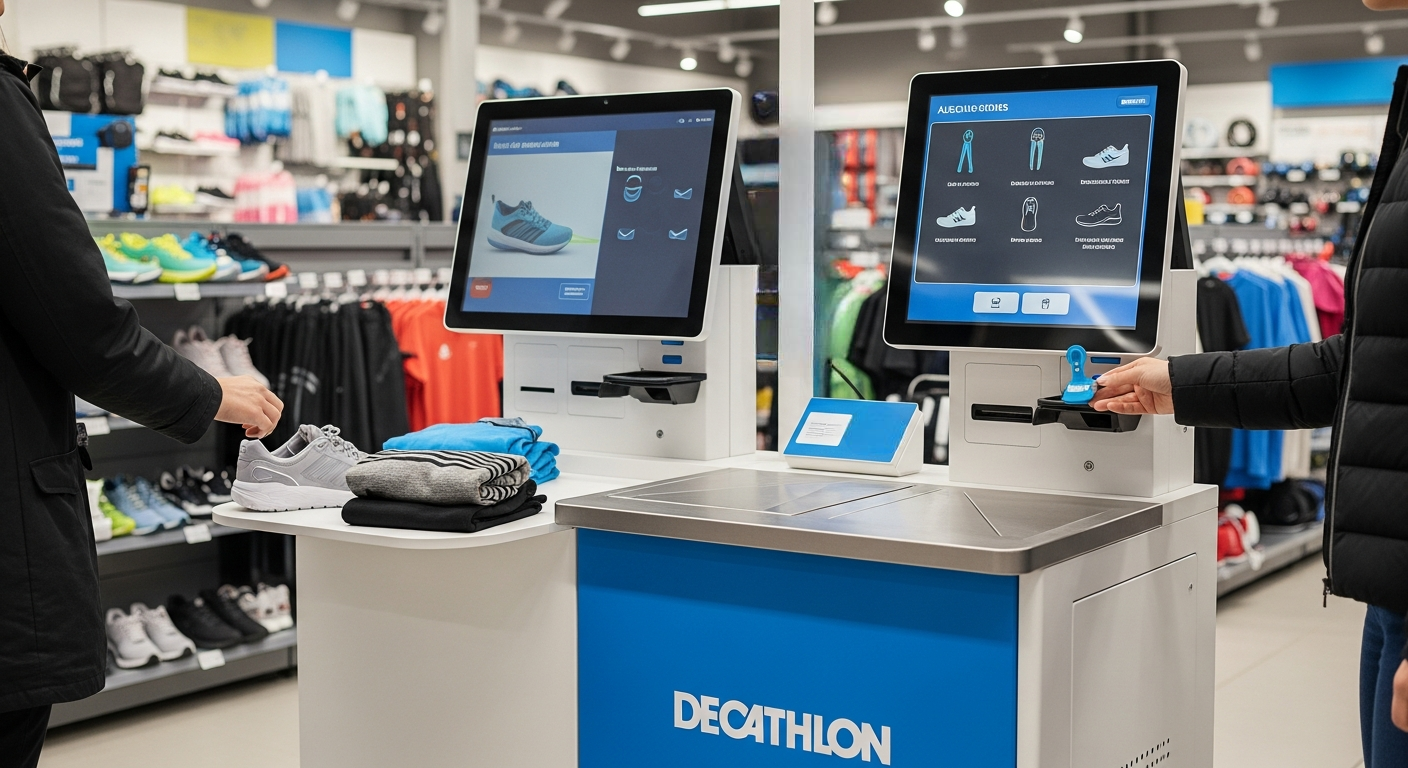
Decathlon’s self-checkout strategy – the Success story
Decathlon is the perfect destination for sports and fitness enthusiasts out there. Products ranging from a tennis ball or jump rope to feature-packed treadmills – Decathlon has a plethora of products that cater to the demands of diverse age-groups.
When it comes to store checkout, Decathlon has been one of the torchbearers of digital transformation in retail. In most of its stores around the world, the company uses advanced tech to make checkout payments fast, effortless, and queue-free.
This blog examines Decathlon’s self-checkout strategy, including how the system works and the benefits it delivers. In fact, a must-read for every retailer out there.
A brief history of Decathlon
Decathlon was founded in 1976, in Englos near Lille, France. The company was found by an entreprenuer and visionary called Michel Leclercq. It was founded with the intention of bringing affordable sporting goods under one roof, making sports accessible to all.
During the initial days, the production was limited to bicycle parts and accessories.
Within 10 years, the company started to produce its own bikes. The in-house production helped significantly to bring down costs of products and other sporting goods.
In the mid-80s and early 90s, Decathlon started expanding to other parts of Europe like Germany, Spain and Italy.
The mid 90s witnessed the company diversifying its product range to newer brands like Quechua (hiking and camping brand), and Tribord (watersports).
Meantime, the company expanded its reach to different continents like South America, Asia and Africa becoming a world-wide sporting goods brand.
In early 2000s, Decathlon took to Digital transformation and launched its e-commerce platform. In 2008, Decathlon started off the implementation of RFID technology for product identification. In 2014, the technology was implemented across Decathlon warehouses and retail outlets. The RFID project of Decathlon is considered as one of the most large-scale RFID implementation projects in the international retail scene.
The year 2026 marks the 50th anniversary of Decathlon’s founding. As of now, the sports good retailer has more than 1700+ outlets spread across 70+ countries.
As of 2024 reports, 101,100 employees work in Decathlon stores, worldwide.
If I put it in minimum words, Decathlon is nothing but “Sports + Tech”.
RFID at Work: The Engine behind Decathlon’s Drop and Go Checkout
Before going to the checkout procedure, allow me to mention a few words about the technology that facilitates checkout.
Decathlon leverages RFID technology to streamline customer checkouts and improve the overall shopping experience in the store.
Each and every product stored in the Decathlon outlet carries an embedded RFID tag. The RFID tag stores the digital information of the product. When the customers place the articles or items into the Drop & Go kiosk basket, an RFID reader automatically detects and identifies this digital information through radio frequency signals. So, the item is instantly added to the cart, and gets displayed on the kiosk touchscreen.
The customer reviews the items displayed in the cart, and makes the payment via any convenient payment modes.
Apart from improving the checkout speed, the technology also ensures stock accuracy and prevents inventory loss. Since, the items are tagged, the technology allows the retailer to efficiently track the inventory across the supply chain.
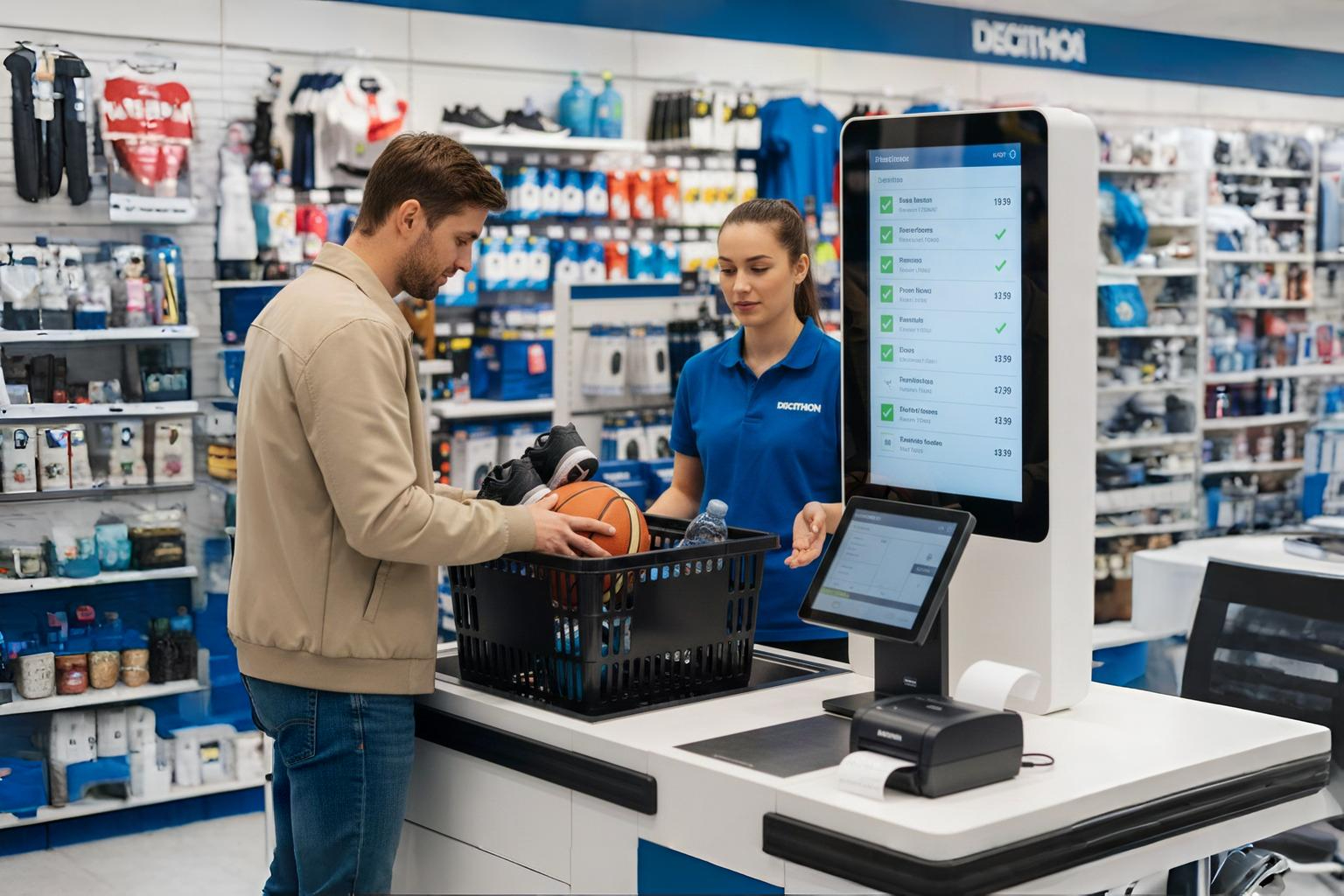
The RFID-enabled self-service checkout
Decathlon has implemented one of the easiest and fastest ways to checkout in a retail environment. The checkout procedure is simple and straightforward.
The steps are listed below.
- Customer registration - The customer registers with a mobile number or email.
- Drop items in the box – The customer is supposed to drop the selected items into the box, one-by-one. Each time the customers drops an item (which is tagged), the RFID reader instantly detects the same. The dropped item gets displayed on the kiosk screen which is mounted behind the box. No wonder it’s called Drop and Go!
- Payment time – Once the customer has placed all the items in the box, it’s time to pay. Customers can make the payment conveniently via card, UPI or gift card.
- Get the transaction receipt – You may opt for a printed receipt of the transaction or receive an e-receipt via SMS or email, whichever convenient.
Dropping the items in the box, the automatic item detection and adding to the cart – all these processes happen in seconds.
Suppose, if you have only a single item to checkout, you can complete the checkout process in less than 30 seconds. It’s that simple and fast!
Assisted Drop and go checkout – For first-time customers who are unsure of the automated checkout process, Decathlon has got them covered. Decathlon is fully aware of the customer psychology and have implemented the assisted Drop and Go facility, where the checkout counters are employee-assisted. Here, checkout employees take care of the entire checkout process, assisting those hesitant customers.
Benefits of the RFID-enabled self-checkout system (retailer perspective)
- Avoid waiting time and congestion at retail – The customers can simply place the items in the basket, and complete the checkout process in minimum time. Say goodbye to the conventional billing counter waiting scene.
- Improved retail throughput – the customer need not scan the items individually. Just place the items in the basket, and that’s it! RFID is extremely fast. The checkout process can be completed in few seconds. Faster checkouts lead to improved throughput.
- Scalable solution – the solution can be easily scaled to meet future expansion demands.
- Better staffing – employees need not engage in repetitive billing tasks, rather focus on higher value customer interactions. For example: Customers might need real-time, face-to-face assistance from employees to select the best bike for rough terrains or road use.
Benefits (customer perspective)
- Customer convenience – The fast, queue-free self-service checkout facility creates a frictionless checkout experience, which adds to customer convenience.
- Customer Empowerment – The customer is in full control of the checkout process with minimum or no interaction with retail employees. Of course, the customer enjoys the privacy in engaging in self-service checkouts.
- Improved retail experience for customers – less time spend for checkout means more time available for exploring and experiencing the store. Your customers are sure to appreciate the added, productive time.
- Reduced errors instil confidence in the checkout process – retail customers can avoid double scan or missed scan scenarios, as in the case of barcode scanning. This reduces checkout-related errors, instilling confidence among customers.
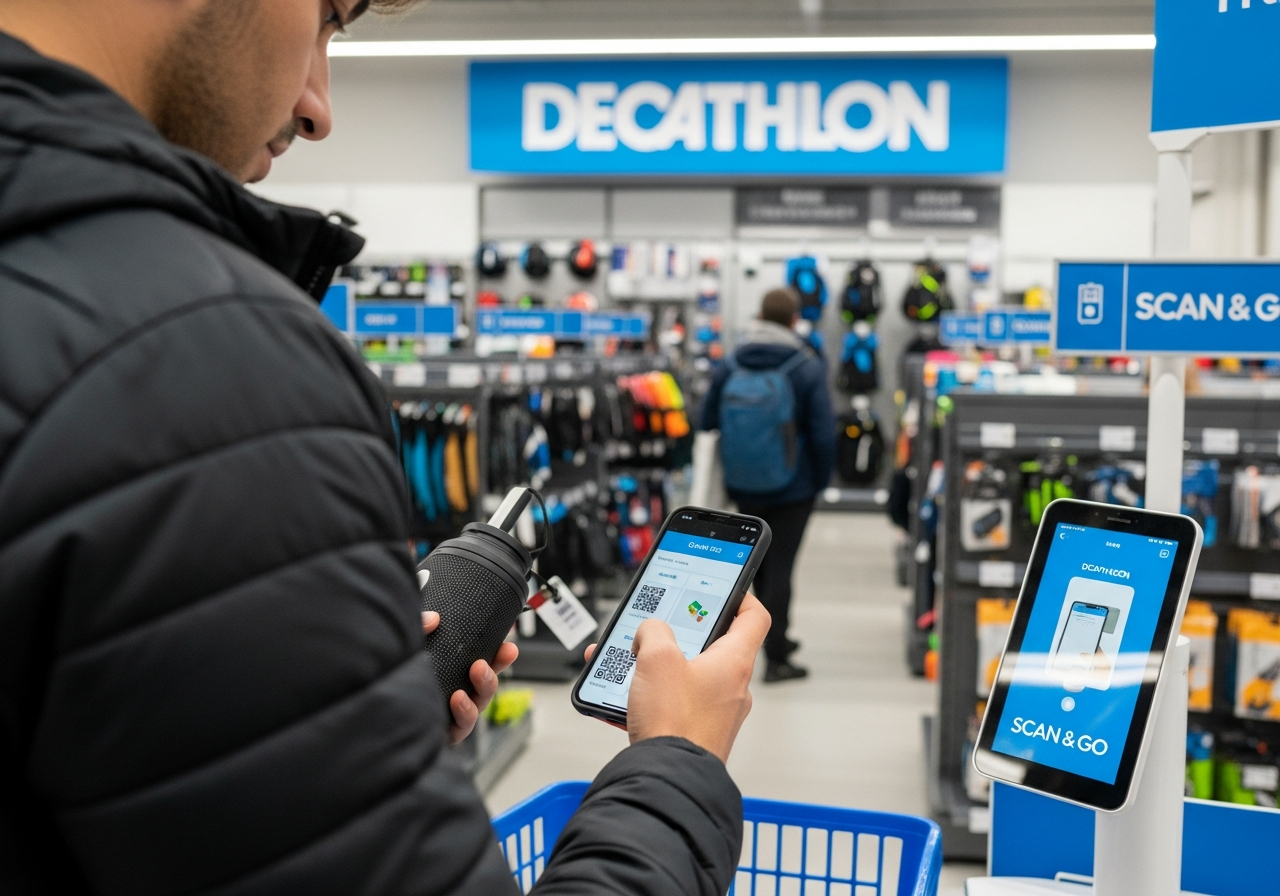
Decathlon Scan & Go checkout
The Decathlon Scan and Go app allows customers purchase products by simply scanning the product barcode/QR code via smartphone, followed by an app-initiated payment. The payment instantly disables the RFID security tag, so that the customers can simply walk out with the purchased product, without spending time at physical checkouts.
What happens behind the scene is that the app payment is linked to the RFID tag attached to the product. Once the customer payment is successful, the RFID security status gets digitally cleared. This allows customers to simply walk out of the store without triggering alarms at the exit.
Benefits of Scan & Go
- Avoid physical checkouts – Decathlon customers can conveniently avoid the physical checkout counter and save their precious time.
- Ideal for weekend and peak-hour purchases – Saves time, especially during peak hours, weekends, holidays and festival days.
- Find and explore products – You can explore the full range of product details and reviews via the app. This helps customers take well-informed decisions prior to purchase.
- Home delivery option – if the customer is interested in “Home delivery” (in case of large bulky products like treadmills, fitness equipment, etc), the person can simply scan the product barcode or QR code, check store availability, and get it delivered to home address.
The RFID Global market size
The major share of the RFID market is owned by the Retail industry which is approximately 35%.
According to the research conducted by Mordor Intelligence, as of 2025, the RFID market size was valued at USD 16.73 billion. By 2031, the value is predicted to grow to USD 32.19 billion, achieving a growth rate of 11.52%.
The rise in growth signals the tech’s move from niche to essential across retail, healthcare, and digital government initiatives. The change is welcoming as far as technology solution providers are concerned.
Decathlon - Key success pillars
Democratisation of sports – Decathlon didn’t focus on the elite sporting professionals or athletes. Instead, they opened the doors to ordinary sports-loving folks, enabling a one-stop destination for all sporting needs under one roof.
Innovation and Research – the relentless effort Decathlon puts into innovation, research, and development, balancing quality and value, understanding the changing needs of sports consumers.
Vertical Integration – Due to vertical integration model, Decathlon has better control over multiple stages of its operations which includes design, manufacturing, logistics and retail distribution. This reflects in the form of improved operational efficiency, better pricing strategy, and consistency in the quality of products.
Digital transformation – Digital transformation has a key role in Decathlon’s overall operations. RFID-driven technology integration, digital tools, data-driven forecasting etc. help the retailer gain better control over the inventory and improve the overall CX.
Select Decathlon stores are hugely tech-driven and are equipped with advanced technologies like VR, kiosk-assisted store navigation etc. to improve shopping experience and customer engagement.
Omnichannel retail experience – Customers perceive Decathlon as a unified sports ecosystem, which reduces the gap between online and offline. Decathlon customers are allowed to purchase the products online or via in-store outlets, choose “Click and Collect” or “Ship from Store” option for delivery, and enjoy a frictionless return or exchange process. The omnichannel retail experience gives customers full control over the entire customer journey. In simple words, customers feel at home!
Customer-centric approach – The global sports retailer places customers at the centre of their business. The user feedback-inspired product design approach, try-before-you buy philosophy, omnichannel convenience, community training and workshop sessions indicate a highly customer-centric approach.
To Conclude
Decathlon’s self-checkout strategy shows how investment in convenience can improve customer satisfaction and store performance. With a reliable checkout strategy in place, you reduce wait times, increase throughput and free staff to focus on merchandising and support. Your business also creates predictable store operations with fewer bottlenecks. The system aligns with how modern shoppers prefer to buy and pay. You give customers control of their time and their shopping journey. This approach makes retail more efficient and more scalable. Decathlon proves that well-planned self-checkout strategies can give a clear competitive edge to your business.
If you get time, please make a visit to your nearest Decathlon store. It’s totally worth your time.
For self-checkout kiosk installation and support, please get in touch with Panashi’s technical team.