
CPR Training Kiosk – Essential Features and Benefits
CPR is the short-form for Cardiopulmonary Resuscitation.
When a person is unable to breathe or when the heart’s beating stops for some reason, it may lead to the individual’s death. The death can happen anytime, maybe in minutes.
Here each and every second is precious.
Performing a CPR on the person at the earliest can save his life. But, you need to know how to perform a CPR effectively.
A CPR training Kiosk helps an individual learn how to perform hands-only CPR on any person, in the most practical of ways, without any external intervention.
This blog sheds light on the CPR Training Kiosk which includes its features, benefits and the way it works. Read on, and spread the news!
What is a CPR training Kiosk?
A CPR training kiosk is a self-service kiosk machine that offers CPR training opportunity for people without the help of a human trainer. The CPR machine presents an interactive, learning experience.
Instead of attending a classroom-based training session, any individual can access the kiosk machine, follow the instructions, and perform CPR on a mannequin attached to the kiosk.
Thus, the kiosk machine serves as a mini CPR training center, that offers 24/7, hands-on CPR training experience to anyone who is interested in learning the CPR techniques.
Other than hospital lobbies, a CPR kiosk can be deployed at any high-footfall locations, which includes airports and malls. The purpose of installation is educating people to perform CPR accurately.
Why CPR training matters?
The American Medical Association advocates for including CPR training in the United State’s high-school education curriculum.
Bystander CPR (receiving CPR from a bystander) can double or even triple someone’s chance of survival, says Dr. Comilla Sasson – an official of the American Heart Association.
It is estimated that more than 400,000 Americans die from a cardiac arrest in a year. CPR Facts and Stats | American Heart Association CPR & First Aid
It’s clear from Dr. Sasson’s statement that – if the CPR is administered immediately after cardiac arrest, the chances of survival can increase by 2 or 3 times. Hence, time is crucial.
I have listed below some of the major benefits of learning to administer a CPR.
- CPR is always a life-saver – Earlier the administration, better the results.
- Reduces/prevents brain damage – CPR is the process of pushing hard and fast in the center of the chest. The rhythmic chest compressions facilitate blood flow to the brain till the help arrives, preventing irreversible damage.
- Improved recovery – quality CPR facilitates faster recovery.
- Perform CPR at home – Most incidences of OHCA (Out of Hospital Cardiac Arrest) happen at homes, at around 73%. So, if your loved ones are at risk, you should definitely learn how to administer a CPR.
- Make workplace safer – it is estimated that around 220,000 people fall victims to Sudden Cardiac Arrest (SCA), per year in the US. Out of which, 10,000 incidences of SCA happen at workplaces. So, if you are trained in administering CPR, you would be the one to save the precious life of a coworker.
- Empowers ordinary people – Rather than watching someone fainting and being clueless of the situation, CPR training empowers people to recognize emergencies, and act at the earliest. To add on, training removes fear, and instils confidence in people.
According to the Heart Disease and Stroke Statistics Update, 2023, out of 356,000 cases of OHCA, a bystander CPR was administered to only 40.25% of the total cases. Heart Disease and Stroke Statistics—2023 Update: A Report From the American Heart Association
This means that the remaining percentage of OHCA cases (close to 60%) did not receive a bystander CPR. The studies indicate the relevance of CPR training, and the need to create opportunities to get proper training.
What are the Features of a CPR training Kiosk
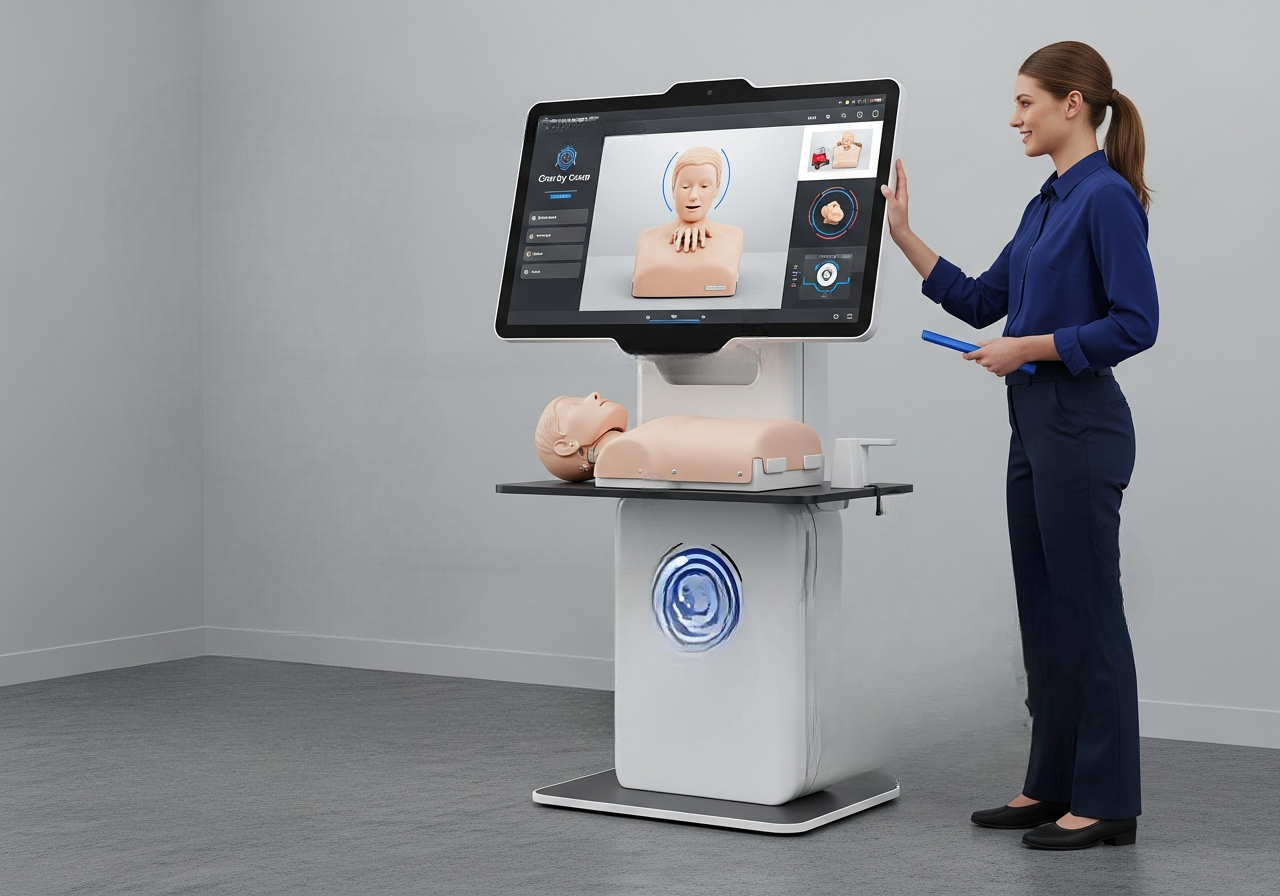
The CPR kiosk machine is loaded with necessary features to provide real-time CPR training. The kiosk is designed in such a manner that a mannequin (practice pad) is fixed on to the surface of the kiosk machine.
- Kiosk touchscreen – displays the step-by-step instructions for the users to perform the hands-on CPR.
- CPR mannequin – A built-in mannequin that measures various CPR parameters like compression depth, compression rate and hand placement.
- Speaker – an inbuilt speaker for voice prompts.
- Multiple training modes – the CPR training kiosk offers multiple modes of training which includes:
- Beginner mode (guided instructions)
- Practice mode (free practice)
- Test-mode (certification)
- Multilingual support – the multilingual feature helps the users to pick their preferred language for CPR training. The feature is highly useful in multicultural societies like the UAE and India.
- Remote monitoring and maintenance – the kiosk operator/admin can remotely monitor the performance of the kiosk machine. The admin can access crucial information related to the kiosk operations like user sessions, daily interactions, trends, etc. via the kiosk software. The admin can also send remote updates to optimize the performance of the kiosk machine, as and when needed.
How does the CPR training Kiosk work?
The CPR training kiosk is a highly practical tool that makes use of hands-on compression technique and real-time feedback.
- Accessing the kiosk machine – The user arrives at the kiosk and selects the preferred training mode.
- Instructions to follow – The CPR kiosk displays the step-by-step instructions along with the audio prompts to start the hands-on training.
- User performs CPR – Following the instructions, the user performs compressions on the mannequin attached to the kiosk.
- Real-time feedback – The mannequin is connected to sensors that pick the nature of compressions, like hand placement, compression rate, and depth. The kiosk then displays those parameters on the kiosk screen real-time. Thus, the users receive instant feedbacks of their hands-on CPR training, which helps them to make necessary corrections, on-the-spot.
- Skill assessment and scoring – Based on individual assessment, the kiosk displays the score based on accuracy and compression quality report.
- Digital certificate issuance (optional) – On successful completion, the kiosk issues a digital CPR training certificate.
Thus, the CPR kiosk machine empowers an individual to perform hands-on CPR training in minimum time, without any human intervention.
Benefits of deploying a self-service CPR kiosk machine
You may install a CPR training kiosk machine at malls, parks, transportation hubs like airports, metro stations, bus depots etc. where people visit in good numbers.
It’s always good to install these training machines where families visit frequently. Families, often accompanied by children, will have the opportunity to observe how the machine works. And, when they see their parents performing the CPR or getting trained, they understand the relevance of CPR, on-the-spot. This creates a lasting impact in their minds about CPR, and they get educated about its benefits at a young age.
Here are the benefits of deploying a CPR training kiosk.
- Acquire a life-saving skill – Performing a CPR on any individual is a life-saving skill.
- 24/7 CPR learning facility – The CPR machine operates 24/7, hence can be deployed in airport settings.
- Cost-effective CPR training – Unlike classroom-based training which involves a certified trainer, CPR kiosk training is cost-effective.
- Fast, effective and gamified learning experience – the CPR training via kiosk takes only 5 minutes, and offers a fun-filled, gamified training experience.
- Acquire training data – the kiosk administrators can acquire valuable data related to kiosk usage, user session etc.
- Remote monitoring – an admin can monitor the kiosk functioning, remotely, from a centralized location. Hence, kiosk system maintenance won’t be problem.
- Easy relocation – if found a better place with greater footfall, you can easily relocate the kiosk machine.
The American Heart Association (AHA) in collaboration with DynaTouch (a US-based technology solutions provider) has deployed CPR Training kiosks at several locations in the US.
Conclusion
Learning to know how to do a CPR, is learning to save lives. It’s no joke – but a must-learn life skill.
I am of the opinion that CPR training should be part of the school curriculums all over the world. Every child should learn this life-saving technique at a young age. According to CPR First Aid, even sixth-grade school children are capable of performing a hands-on CPR, when it is most-needed.
Performing a CPR on any individual should not be a doctor-dependent affair.
Each and every one of us should have the necessary skills to perform a CPR in an emergency. A CPR training kiosk is a cost-effective, yet highly efficient way of providing CPR training to the public.
There is a strong need for the governments and healthcare businesses around the globe to take a keen interest on this life-saving kiosk machine, and facilitate its widespread deployment.
Spread the news of CPR training, and thereby, become part of empowering the citizens.