
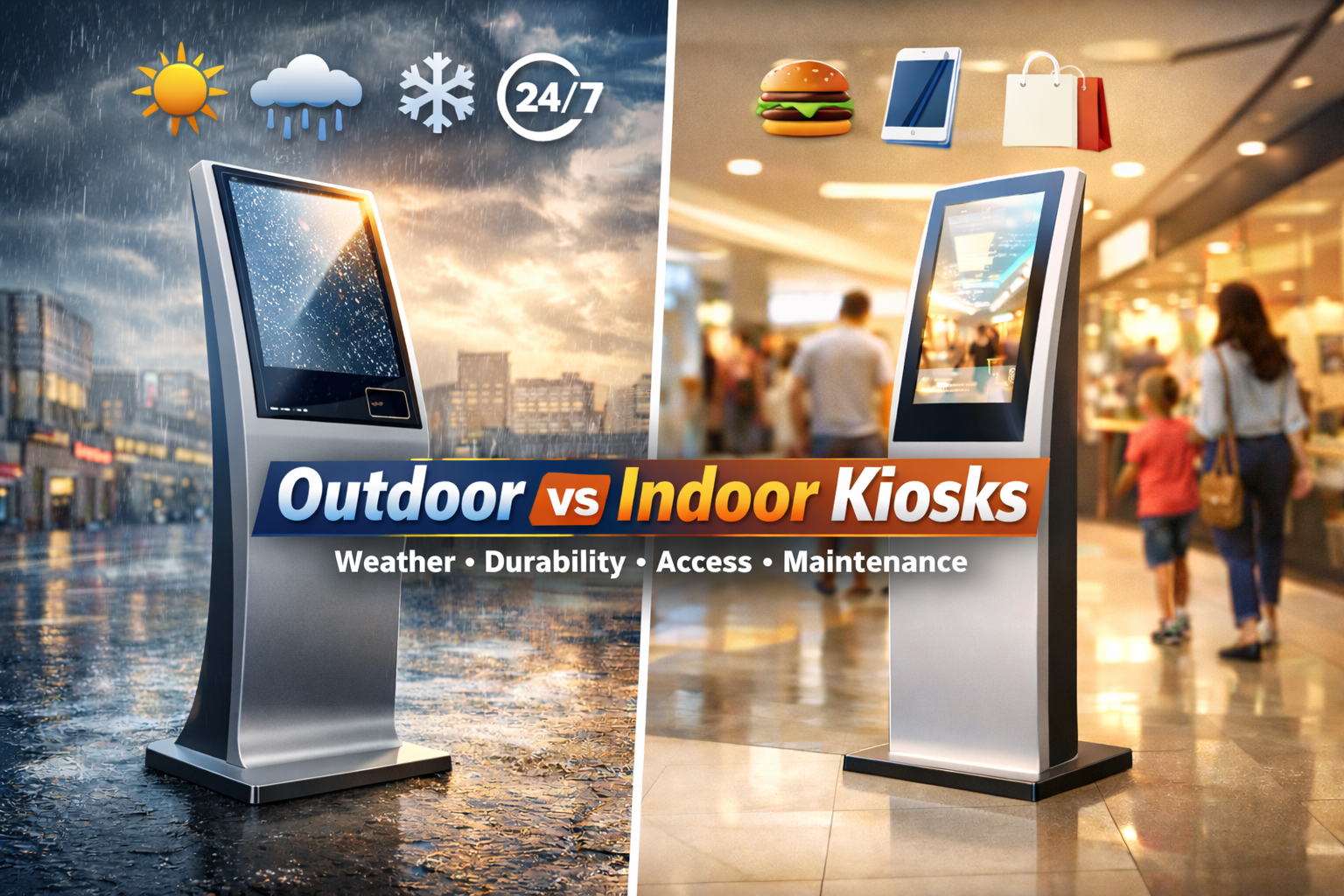
Outdoor vs Indoor Kiosks Explained
Self-service kiosks come in various formats and designs. We see these kiosk machines in both outdoor and indoor design formats in diverse sectors. Beyond the literal sense, have you ever wondered about the actual differences that exist between outdoor and indoor kiosk machines?
Whether to install an outdoor or indoor kiosk has much more to do than mere placement considerations.
Each option presents distinct advantages, challenges, and technical requirements that can significantly impact the operational costs, usability and maintenance requirements.
Getting these details right from the start can save you headaches and money down the road.
In this comparison between Outdoor kiosk Vs Indoor kiosk, I will let you know the main differences between Outdoor and Indoor kiosk machines with respect to certain key factors. This would certainly help you make well-informed decisions regarding the most feasible option for your business.
Kindly, read on…
1) Location of deployment
Outdoor kiosks
Outdoor kiosk machines are commonly deployed in connection with large events or festivals for the purpose of ticket issuance.
Several government organizations and public sector agencies deploy outdoor self-service machines to offer a plethora of citizen-centric services like bill payment, information disbursal etc. These outdoor machines can be seen on city sidewalks, in busy junctions, or city squares, where people come in large numbers.
You can also spot these machines at transit hubs, metro stations or any public transportation facility. Travelers and visitors can easily dispense or book tickets via the kiosk machines without having to wait at the ticket counters. Yes, you know it – it’s definitely a time-saving affair.
In short, outdoor kiosk machines, as the name suggests, are installed in outdoor environments. As a result, they are prone to the forces of nature like rain, wind, dust, sunlight, humidity etc. For the same reasons, they are built rugged, and their enclosures made of highly durable steel.
Panashi had recently installed an Outdoor drive-thru kiosk for Khorfakkan Municipality in the UAE. The kiosk machine helps residents access Municipality’s service-related information without having to visit its building premises. Since, the outdoor kiosk is a drive-thru, the citizens can access information from the comfort of their cars, without getting out or parking the vehicle at the parking lot. This means that residents need not stand in the long lines at the information counters or even wait in the reception area for the sole purpose of information access. As a result, the Municipality premises is freed off from congestion, which in turn, streamlines its day-to-day operations.
You may learn more about this outdoor-drive thru kiosk here.
Indoor kiosks
Indoor kiosk machines are usually deployed in indoor or protected environments like malls, restaurants, airports, retail settings etc. They perform indoor functions like order-processing in restaurants, passenger check-in and wayfinding in airports, self-checkouts in retail settings etc. The indoor kiosk machines come with a decent build-quality, however, they are not meant for outdoor settings. They are not built to withstand harsh weather conditions like rain, wind, extremes of temperature, sunlight etc. and hence deployed indoors.
2) Weather protection
Outdoor kiosks
Outdoor kiosks are weatherproof machines. They operate day-in and day-out,24/7 under harsh weather conditions. The kiosk enclosures are made out of IP 65/ IP 67- rated durable steel, so that they can withstand harsh climate.
IP65 and IP67 ratings are a measure of ingress protection. These ratings indicate a product’s capability to withstand dust and water.
IP65 – An IP65 rating indicates complete protection from dust and splashes of water. Panashi Outdoor kiosks are equipped with a Multi-layer filtering system that prevents the entry of dust into the kiosk.
IP67 – An IP67 rating indicates complete protection from dust and also offers an additional feature of water immersion protection of up to 1 meter and 30 minutes duration.
To add on, outdoor kiosks are equipped with high-resolution, sunlight readable screen that facilitates screen reading even during high intensity sunlight.
For an in-depth understanding of IP ratings, please visit the website.
Indoor kiosks
Indoor self-service machines are installed in indoor or protected environments, and therefore, are not exposed to harsh weather. And hence, they are of standard build.
The high-resolution sunlight readable screens are not present in indoor kiosks.
3) Durability
Outdoor Kiosk
The kiosk enclosures are specially-treated and painted to offer maximum weather resistance and durability. Outdoor weather conditions are unpredictable. At times, you experience a hot sun, and maybe after few hours you get heavy rains. Kiosk enclosures are treated with anti-corrosive coating and industrial-grade paint to withstand extremes of temperature, rain, dust, and sunlight. This unique treatment protects the enclosure from harsh weather conditions and possible wear and tears.
It’s not just the weather that matters. There are security aspects too. The rugged build quality of outdoor machines makes them tamper-resistant and protects them from acts of vandalism or other external impacts. Whether these machines are deployed in high-traffic or remote areas, the reinforced steel enclosure serve as a protective shield. This ensures safety and reliability, which helps to gain the trust of users.
Indoor Kiosks
Indoor kiosk machines make use of lighter materials as they operate in indoor environments. Due to the same reasons, they are less resistant towards vandalism or external impacts. However, due to the use of lighter materials, the indoor machines offer greater design flexibility and are more aesthetically appealing than the outdoor machines.
4) Temperature range
Outdoor Kiosk
Temperature in arid regions can go as high as 50 degree Celsius during the hottest months. It can even drop to 10 degree Celsius at night, creating extremes of temperature.
Outdoor kiosks are prone to these extremes of temperature which can affect the performance and life of various electronic components. Hence, temperature control is one of the major considerations in the design aspects of Outdoor kiosks.
Outdoor kiosks are equipped with Intelligent temperature control systems that effectively control the temperature variations to deliver optimum performance of the kiosk machine. To add on, the dedicated temperature sensors give timely warning messages or alerts to the kiosk operators whenever the temperature rises above a preset value.
Service providers and business may deploy Panashi Outdoor kiosk machines for a wide range of operations in various climatic conditions. The operational temperature of our outdoor kiosk machines ranges from -30 to 60 degree Celsius.
Our outdoor machines managed the ticketing operations at the Sheikh Zayed festival, the annual cultural event held in Abu Dhabi. 60 outdoor kiosk machines performed the ticketing tasks under the scorching heat of the sun with top-notch efficiency!
To read more about Sheikh Zayed Festival Outdoor ticketing kiosk, visit our Projects page.
Indoor Kiosk
Whereas, indoor kiosk machines operate in controlled/protected environments, where the temperature almost remains a constant or the temperature variations are negligible. So, in most cases, these machines are not equipped with active temperature control systems.
5) Access to Kiosk machine
Outdoor Kiosks
As outdoor kiosk machines are installed in outdoor environments, they are accessible for the users 24/7. You may easily locate these outdoor self-service machines on sidewalks, transportation hubs, parking lots, or outside building premises, or just anywhere with a decent foot traffic. This continuous availability makes people access services at their most convenient time, whether it’s during business hours, late at night, early mornings, weekends or holidays.
It completely eliminates the conventional scenario of desk-based counters that operate within fixed timings, normally business hours. Yes, flexibility and convenience are the two aspects that attract folks to these outdoor machines. The outdoor machines are always ready to assist, anytime, anywhere.
Indoor Kiosks
As indoor self-service machines are installed in protected environments, they are usually installed inside the building premises of the service provider. Hence, the operational time of the indoor machines is much limited. In most cases, the time is confined to the regular working hours of the ser vice provider or business. Hence, the 24/7 kiosk access is not possible, unless the service provider is open throughout the day.
6) Kiosk maintenance
Outdoor Kiosks
- Prone to external factors – As outdoor kiosks are installed in outdoor environments, they are subject to forces of nature like rain, humidity, wind, and dust. Therefore, these machines are prone to corrosion, rust, accumulation of dust, and in some cases, insect infestation.
Hence, service providers should conduct regular inspection and maintenance activities to detect and fix these issues.
- Hardware fatigue – temperature variations may result in hardware fatigue, and may affect the performance of various hardware components, if left unchecked.
The shift between extremes of temperature causes the materials inside the kiosk machine to undergo physical changes. The materials include metals parts, plastic components and even the circuit board. The temperature variations can twist or bend the circuit board, weaken the solder joints, or even damage insulation, resulting in small cracks or component failures. And when these issues go unnoticed or unchecked, they affect the performance of the kiosk machine, resulting in increased maintenance costs, unexpected kiosk downtime etc.
- Hardware maintenance – the cooling systems installed in the outdoor machines require routine servicing. Outdoor machines are equipped with cooling systems like fans, ventilation systems, and even air-conditioning systems to regulate the inside temperature. They play an important role as they prolong the life of various electrical and electronic components, and thereby, offer an optimum kiosk performance.
Lack of timely maintenance can cause issues like buildup of dust, clogging, worn-out fans, coolant leaks etc. This can result in temperature rise and affect the performance of various kiosk components. And, when you maintain them systematically, they reduce the chances of thermal failures.
- Tampering and vandalism – Outdoor kiosks are more prone to tampering and vandalism. Hence, the kiosk enclosures need to be tamper-proof, and should be securely mounted to the ground. The kiosk maintenance team or personnel should conduct regular inspections to check any sings of tampering, theft or vandalism.
- Maintenance cost – Routine inspections, cleaning, servicing of parts or replacement (if needed), results in higher maintenance costs.
Indoor Kiosks
Indoor kiosks are deployed in controlled or monitored environments, and hence, they are protected from the forces of nature. Therefore, the frequency of inspection and maintenance activities are less compared to the outdoor kiosks.
Indoor kiosk machines do not experience much temperature fluctuations, and hence, hardware fatigue is not much of an issue.
In most cases, indoor machines are not equipped with cooling systems, unless they are deployed near heat-generating environments. Hence, inspection and maintenance of cooling hardware is much limited.
As the machines are well-monitored in indoor environments, indoor machines are not affected by tampering, theft or vandalism.
Reduced frequency of inspection, cleaning and service-related activities, kiosk installation in protected indoor environments, etc. keep the maintenance cost less.
7) Kiosk Applications
Outdoor Kiosk
Outdoor machines are generally implemented for services that are citizen-centric, even though there are exceptions. I have listed few examples below.
- Ticketing – Ticketing kiosks perform ticketing tasks for major events and festivals. These ticketing machines also handle ticket dispensing for transportation hubs, metro stations, ferry terminals, railway stations, etc. thereby streamlining the ticketing operations.
- Bill payment – Bill payment kiosks performs payment processing of various kinds like utility bills, traffic fines, telecom bills etc. The users can scan their Customer ID or National ID card to fetch the bill, make payments via diverse payment modes, and collect receipt of payment within few minutes.
- Information access – Information kiosks are commonly found in parks, public spaces, busy junctions, tourist spots, etc. and they display a wide range of information like city maps, directions, public notices, weather updates etc. They provide updated, real-time information to residents and visitors serving as automated information portals.
- Smart city – Smart city kiosks are installed in public places, near busy junctions, or in urban streets. They are loaded with a host of features like public Wi-Fi, SOS button, surveillance camera, environment monitoring systems, etc. to handle the evolving needs of smart cities. These smart machines improve security and surveillance of smart cities, enhance connectivity and promote community engagement in urban locales.
- Parking – Parking kiosk machines handle automated parking in outdoor settings like busy streets, malls, airports, etc. The users can check parking availability, make payment for the parking duration, and collect payment receipt – all via the kiosk machine.
Indoor Kiosk
Indoor kiosk machines are usually deployed in controlled environments like retail sector, restaurant and hospitality, healthcare etc.
- Food ordering – I’m pretty sure, you are familiar with self-ordering kiosks or restaurant kiosks which are installed in QSRs, fast-food outlets, and other eateries. These indoor kiosk machines simplify and automate the food-ordering process. The customer browses through the list of dishes, pick the preferred one, performs customization, places the order, and finally makes the payment. The process gets completed with a few taps on the kiosk screen. No queues, no waiting, no order errors, just pure pleasure of dining!
- Retail check-in – Retail check-in kiosk are usually found in retail settings like department stores, supermarkets etc. The retail check-in kiosk allows customers scan and pay for the products without having to interact with a cashier or store employee. This reduces long lines, delays, congestions and other retail inefficiencies.
- Guest check-in – Guest check-in kiosks are employed in hospitality sector like hotels, resorts, to automate visitor check-ins and check-outs. The guests can input the Booking ID or their personal credentials on the kiosk screen, confirm their reservation, and receive room-key with ease. These hospitality kiosk machines reduce wait time and improves guest satisfaction.
- Patient check-in – Patient check-in kiosks are widely deployed in hospitals and other healthcare facilities to automate patient check-in. The patients can enter their Hospital ID or appointment booking details and confirm their appointments without having to interact with the hospital front desk staff.
Conclusion
Outdoor kiosk Vs Indoor kiosk selection can be tricky, at times. It involves precise understanding of your customer needs, business goals and operational requirements.
Outdoor machines offer 24/7 access to your customers. And they handle high-traffic requirements too. However, they demand more maintenance compared to the indoor machines.
Indoor kiosks offer design flexibility and less maintenance, but can limit your operating hours. To add on, deploying these machines can pose problems, if you have space-related constraints.
Ultimately, there is no magic formula for everyone.
You’ve to consider multiple aspects like upfront costs, maintenance expenses, design and aesthetics, user demography, etc.
Consider whether 24/7 access actually matters to your customers. And, of course, be realistic about what your location can handle.
Most importantly, learn how your customers want to interact with your business or service. It’s crucial!