
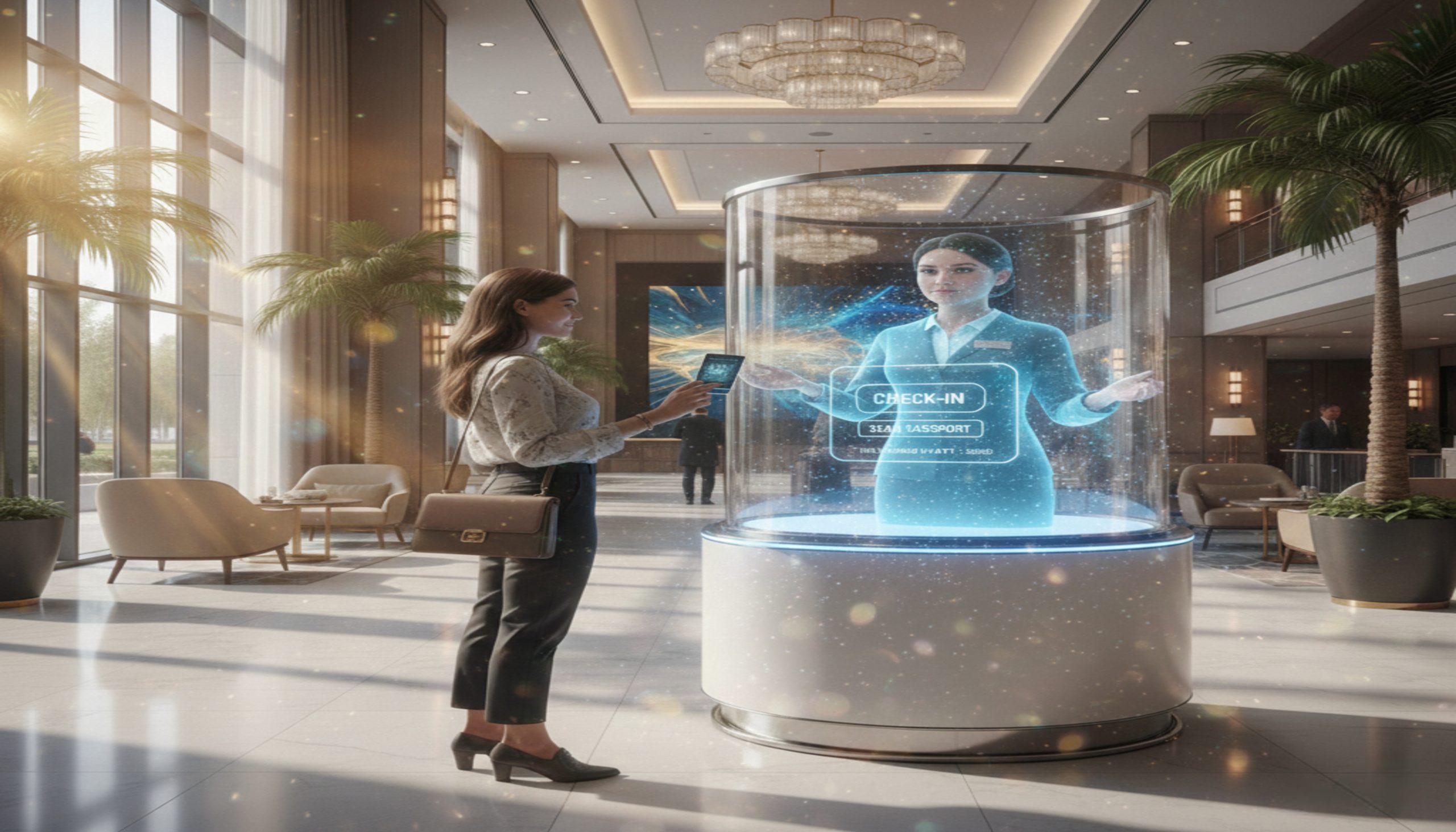
AI-powered Holographic Avatars: The Hotel Check-in Innovation
AI-powered holographic avatars could soon become a new benchmark for innovation in hospitality services.
These holographic 3D avatars serve as your 24/7 receptionist or front office agent that offers real-time, human-like interactions with guests.
The holographic avatar is integrated with the hotel’s property management system (PMS). As a result, the guests can easily perform hotel bookings, do check-ins, get a room card key, and engage in several other interactions with ease.
For someone witnessing the 3D holographic Avatar for the first time at a hotel lobby, would feel like a sci-fi movie character waiting to solve your queries. Yes, it’s that cool.
This blog lets you know more about this hospitality innovation in layman’s language.
Stay tuned.
What is an AI-powered Holographic Avatar?
In simple words, they are AI-powered, 3D digital characters that appear as holograms and mimic human facial expressions, voice, and gestures in real-time.
They are engaged in several service sector domains where real-time customer interactions matter a lot. For example: Hospitality, healthcare, customer service, entertainment, governments etc.
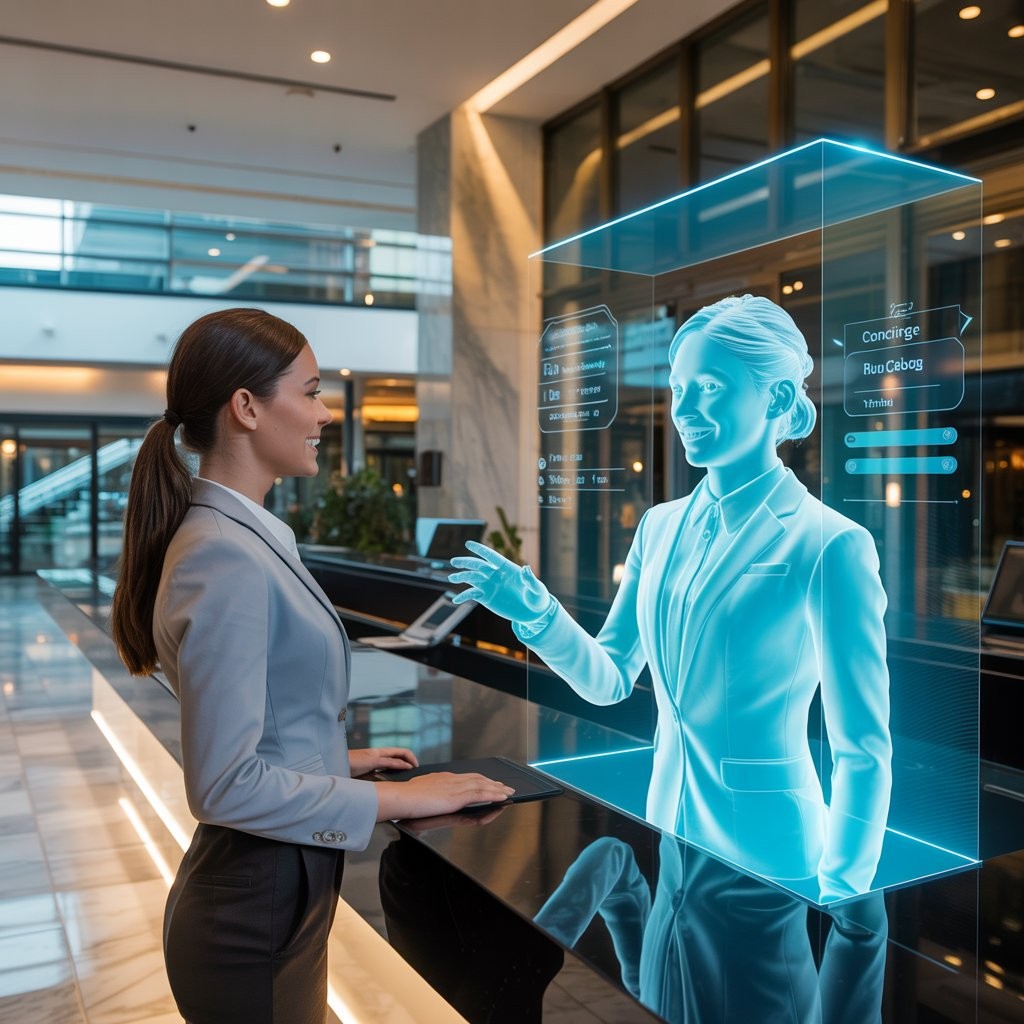
The Holobox AI avatars – the hospitality check-in innovation
Gone are the days when guests arrive late at midnight or in the early morning hours, waiting in the lobby, to do the check-in.
Nowadays, hotels implement automated check-ins with the help of self-service hotel-check-in terminals.
The kiosk-assisted hotel check-in eliminates the need of a front office staff to handle guest check-in tasks.
The 3D holographic avatars are one step ahead. They redefine hotel check-in process by creating an immersive, engaging and fun-filled experience that closely resembles human-intervened interactions.
I am pretty impressed with the Holobox-based AI-powered holographic avatars implemented in the properties of CIC Hospitality – a Scandinavia-based hotel operator. CIC operates around 30 hotels in Scandinavian countries like Sweden, Denmark and Norway. CIC – which stands for Caring, Inspiring and Creative, aims to be a leader in hospitality by leveraging advanced technology and following a customer/guest-centric approach. The hotel operator is headquartered in Oslo, Norway.
The AI holographic Avatar is a human-like, real-time digital Avatar that helps guests perform check-in/checkout, generate room card key, and access various other services without any human interaction. The services include asking general queries, booking restaurants, cab booking, enquiring about sightseeing locations, etc.
CIC Hospitality – in collaboration with multiple technology solutions providers have implemented the technology in several Scandinavian locations.
The technology solution providers are listed below.
- Holoconnects – a 3D Holographic solutions provider based in Culemborg, Netherlands.
- Mews – A cloud native, Hospitality Management system provider headquartered in Amsterdam (Netherlands)
- RAVATAR – A technology solutions provider that specializes in real-time AI Avatars, headquartered in Limassol, Cyprus.
A Holobox is a large-sized enclosure equipped with an 86-inch, transparent screen with 4K resolution, and it displays 3D holographic images of humans, products, and logos.
Here is how the guest check-in process works.
Ravatar’s real-time AI Avatar operates through Holoconnects’ Holobox. A 3D holographic visualization of a front office staff with 4K high resolution is created, which produces a human-like, immersive experience.
As the guest arrives at the lobby, a Motion sensor detects the person. The guest can choose from multiple options that are displayed on the Holobox touchscreen display which includes:
- Perform check-in
- Access food, fun and other services.
- Know more about hotel
- Call a live host
The guest can select the option to interact with a live agent. Once selected, the 3D holographic Avatar immediately appears inside the Holobox, and welcomes the guest. The interactions are just like what a real human reception staff would do during guest check-in.
Such a 3D holographic Avatar is implemented at the Aiden by Best Western, located in Denmark.
And, here is what the Holoconnects CEO, Andre Smith has to say about the Hospitality innovation.
“The launch of a virtual avatar greeter is an exciting new step forward for Holoconnects and the hospitality sector as a whole. We believe it will ultimately elevate and improve the guest experience and overall hotel customer satisfaction.”
As per the statement of CIC Hospitality CEO, Matthias Tanski – “This launch underscores CIC Hospitality’s commitment to leveraging innovative technology to transform guest experiences. We are excited to collaborate with Holoconnects and Mews to explore how cutting-edge solutions like this holographic front desk avatar can enhance the hospitality landscape”.
Holographic Display market size
As per the research conducted by Mordor Intelligence, the holographic display market, as of 2026, is valued at 5.14 billion US dollars. By 2031, the value is expected to reach 11.66 billion US dollars, achieving a CAGR of 17. 82%. And, the middle-east is considered as one of the fastest growing markets in the world.
What are the benefits of deploying a 3D holographic Avatar at a hotel reception?
A 3D Holographic avatar is not just a flashy gimmick that enhances the hotel reception ambience. It’s much more than that. Here are those benefits.
Improves Guest Engagement and Experience
The free-floating holograms have the capability to catch the attention of users/customers in multiple environments like retail, hospitality, museums, and even in public locations.
- Your guest would simply love to interact with these avatars. Apart from booking rooms, issuing room card keys, they also offer legitimate, updated information about sightseeing, hiring a cab service, and many more.
- The Avatars perform upselling through premium room recommendations for a discounted price. Most of the times, the guest accepts the deal, if the person understands the value of the offer. To add on, it’s almost a human who is making the offer!
- The multi-language facility helps guests to interact in their preferred language. The feature is highly helpful for international tourists and guests.
Improved front-office efficiency
Employees need not manage the low-value, monotonous, front-desk responsibilities, instead, they can take up more customer-centric tasks.
No unwanted waiting at the lobby, no time wasted. Your guest reaches the room with the room card key at the earliest.
Smooth, convenient check-in/checkout
The “Avatar receptionist” facilitates both early and late-night check-ins or checkouts. The guest’s arrival time and the availability of staff won’t be a problem anymore.
Accessibility, thereby, inclusive hospitality
Guests with mobility issues and limited vision can interact easily with the 3D holographic avatar. The natural human-like conversations and gestures of the Avatar put the guests at ease.
Branding benefits
- Tech-forward image – the 3D holographic avatar at the lobby enhances the hotel’s brand value, bringing in a futuristic appeal.
- Social mentions – Guests are likely to share the Avatar interactions on various social media platforms, which offers free social publicity.
- Competitive edge – Gives a clear competitive edge, especially for business and luxury hotels.
Modular Holobox illusion
When multiple Holoboxes are placed next to each other, the thin screen bezel can create an illusion of a holographic Avatar passing through the boxes. This modularity can improve customer engagement, especially in retail and other public settings.
Brings down staffing requirements
A front office staff located in a centralized location can work for hotels operating across multiple cities or countries.
Reduces labour cost
Through front-office automation, the hotels can effectively manage staffing and operational expenses.
What are the other applications of the 3D holographic Avatars?
The 3D holographic Avatars have plenty of other applications too. And, I have listed some of the major ones below.
Retail and Advertisements
Hologram display advertisements can easily capture the attention of public, especially in high-foot traffic areas or malls. The realist appearance of the product, message or an individual can trigger so much of excitement and curiosity among the viewers, improving customer engagement.
Hologram contents are ideal for product launches, automotive advertising, storytelling, interactive marketing campaigns, virtual brand ambassador interactions, influencer interactions, etc.
In Belgium, BMW unveiled its sedan BMW i5 through a Holographic Wall. The 360-degree immersive experience received much appreciation.
Healthcare
Remote consultation – 3D holographic Avatars improve doctor-patient communication through remote consultation. A medical practitioner can easily communicate with patients located across multiple countries which reduces the need for travel. The communication with high-resolution, human-like 3D avatars instill confidence and trust among the patients.
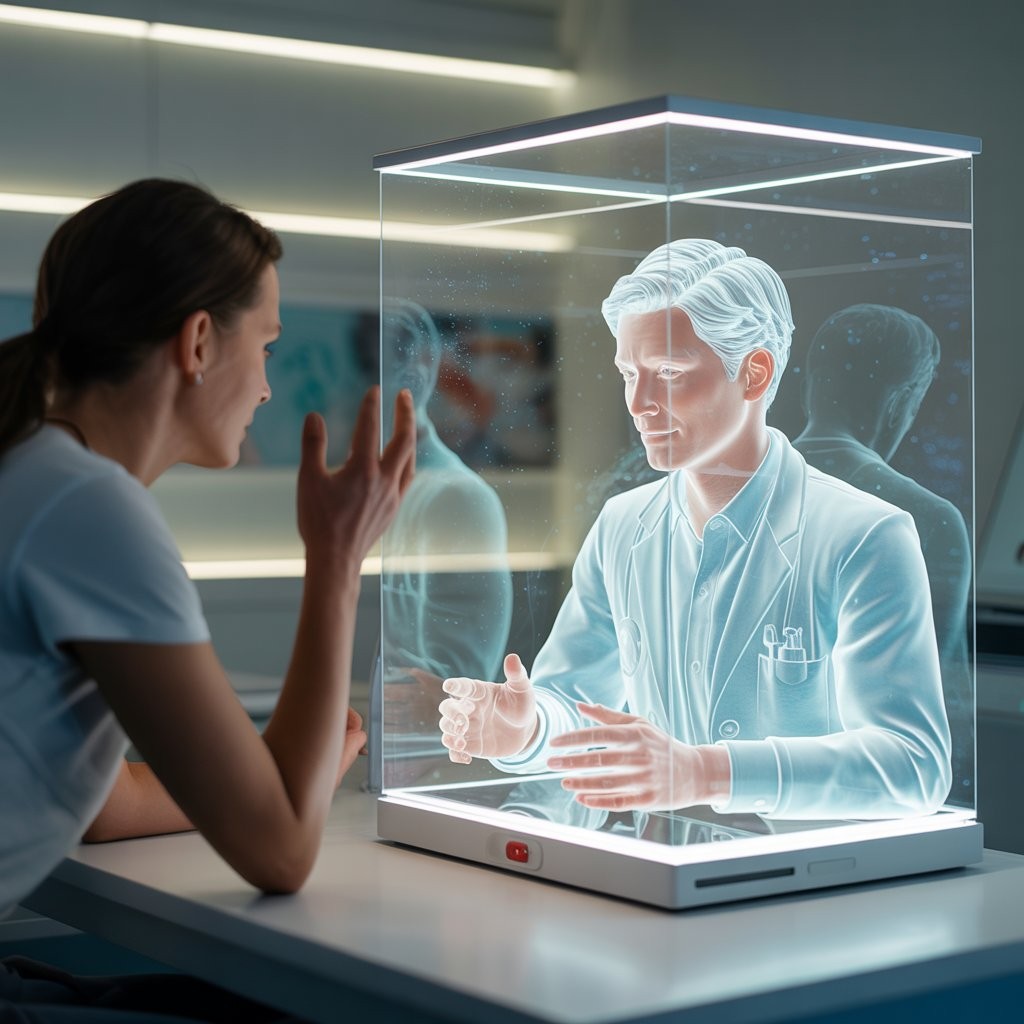
- Improved medical diagnosis – Medical experts and clinicians can access 3D visualizations of organs, tissues, tumors, and other abnormalities. This offers far better results compared to the conventional CT, MRI or ultrasound scans.
- Medical education and training – Medical students can study life-size holographic organs which facilitates better retention compared to the 2D screens.
Entertainment
Live performances and concerts – performers or stage artists appear as 3D holographic projections which is ideal for virtual concerts or tour programs.
In 2018, the German circus named Roncallia, did something exceptional with holographic technology. The real-life animals like horses and elephants were replaced by holographic 3D projections. Apart from offering a visual treat, the circus received much appreciation for its animal-friendly approach.
World-renowned artists like Michael Jackson and Tupac Shakur were displayed through holographic projections to impress fans in concerts.
Conclusion
Guest expectations continue to shift toward convenience and tech-enabled experiences. Holographic avatars present the advantage of warmth, personlisation and an element of human connection during guest interactions. These 3D wonders position hotels at the front line of smart, future-ready hospitality.
The 3D holographic avatars can significantly change the overall front office experience in hotel chains. For tech-driven hospitality operators, the 3D holographic display technology offers much to explore.