
How Queue Management Systems Make Hospital Visits Easier
Imagine walking into a hospital reception with an ailment, only to find long lines of patients, unclear instructions, congested waiting room etc. You would surely feel like cancelling the visit, and getting back to your home.
It’s a highly frustrating experience for patients, and challenging for hospital staff as well.
In a scenario where every minute is precious, prolonged waiting time, long lines and congestion not only affects patients, but interrupts patient care, and affects the overall operational efficiency of your healthcare facility.
An existing patient has (60-70) % chance of revisiting the healthcare provider, which means that the person is likely to revisit as part of the next appointment. This also means that around (30-40) % of the existing patients are not likely to revisit for some reasons. And, those reasons are largely connected with the overall patient experience.
And, when these issues are not checked, they are going to adversely affect the reputation of your healthcare establishment.
Here lies the relevance of dedicated hospital queue management systems.
In this blog, we’ll discuss the top 7 benefits of implementing Queue Management solutions in hospitals. So, stay tuned…
What is a Queue Management System (QMS)?
In simple terms, a Queue management system is a centralized system that automates queue management, thereby tracking and optimizing the real-time customer/visitor flow.
This centralized system helps to reduce visitor waiting time, boost customer satisfaction and improve the overall operational efficiency of the service provider. The solution comprises both hardware and software components like check-in kiosk terminal, display screens, Queue management software etc. to efficiently monitor and manage the customer/visitor flow.
Queue Management Systems are commonly deployed in hospitals, health diagnostic centers, airports, government departments, and at other service-based establishments where foot-traffic is high.
Key Components of a Queue Management System
Hardware components
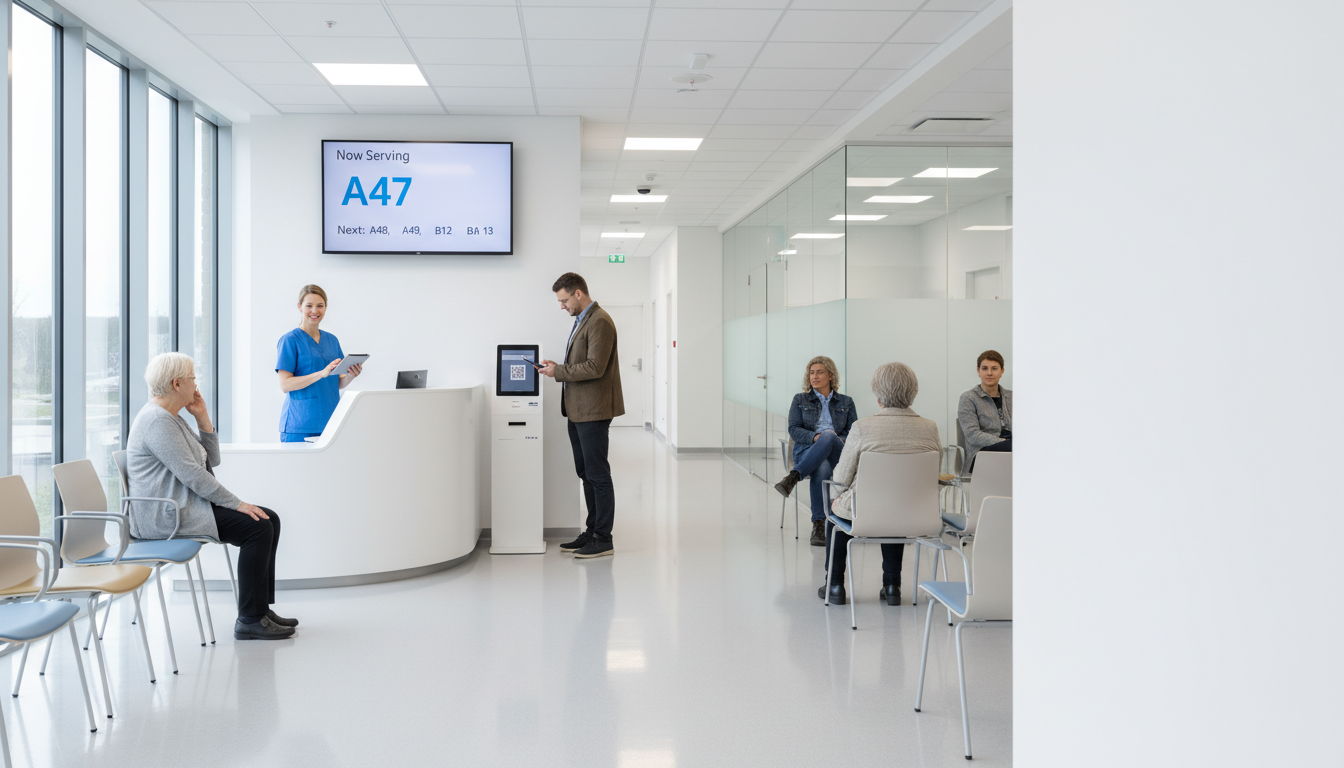
- Digital display screens – the digital screens, usually of the wall-mounted type, display real-time information related to queue status, counter numbers etc.
- Self-service check-in terminals – These self-service patient check-in terminals are deployed near the reception or front desk area. The kiosk machine offers several services like automated patient check-in, appointment booking, medical records access, patient information update etc. And the interesting part, the patients can access this information with a few taps on the kiosk screen. Panashi patient check–in kiosks are perfectly compatible with your Queue Management software. For more information regarding, Hospital check-in kiosk, please visit our blog page, here.
- Counter display Units – Counter display screens are usually wall-mounted screens that are deployed above or adjacent to the service counters. And they display the real-time ticket status to the patients.
- Audio announcement system – The system announces the counter number and the ticket number, and guides the patients to the respective counters.
Software components
- Queue management software – the central software that manages and optimizes patient flow, performs patient routing to specific departments, handles ticket issuance etc.
- Admin dashboard – the centralized dashboard allows the system admin to monitor the patient queues real time.
- Reporting and Analytics module – the module gathers certain crucial information related to patient flow like peak hours, average wait times etc. It provides data-backed information regarding service efficiency.
- Customer Appointment system – web-based and mobile-integrated systems that facilitate patient booking schedules. The system plays a major role in managing the flow of walk-in patients.
- Mobile app/ SMS integration – notifies patients regarding their appointment status, estimated wait times via SMS or app notifications.
- API integration – connects Queue Management System (QMS) with Hospital Information Systems (HIS).
Certain thought-provoking statistics
Here are some interesting statistics on patient wait time gathered from different parts of the world.
- The median patient waiting time, from the time of triage to the doctor meeting time, in an emergency department of a tertiary healthcare provider in Saudi Arabia was 35 minutes.
- According to Statista, the average wait time for a general practitioner’s appointment in the US, in 2023, was estimated to be 21 days. When it comes the UK, it was 10 days.
- According to a survey conducted by Australian Bureau of Statistics in 2023-2024, 28% of patients reported longer waiting times for a GP appointment.
- Several factors determine patient wait times in India like the excessive patient load, staffing scarcity, time-consuming patient-registration process etc. The patient wait time varies with State, government-owned & private healthcare facilities etc. Government hospitals, due to the excessive patient load, report patient wait times ranging from 20 to 40 minutes or even more.
Benefits of Queue Management System for healthcare
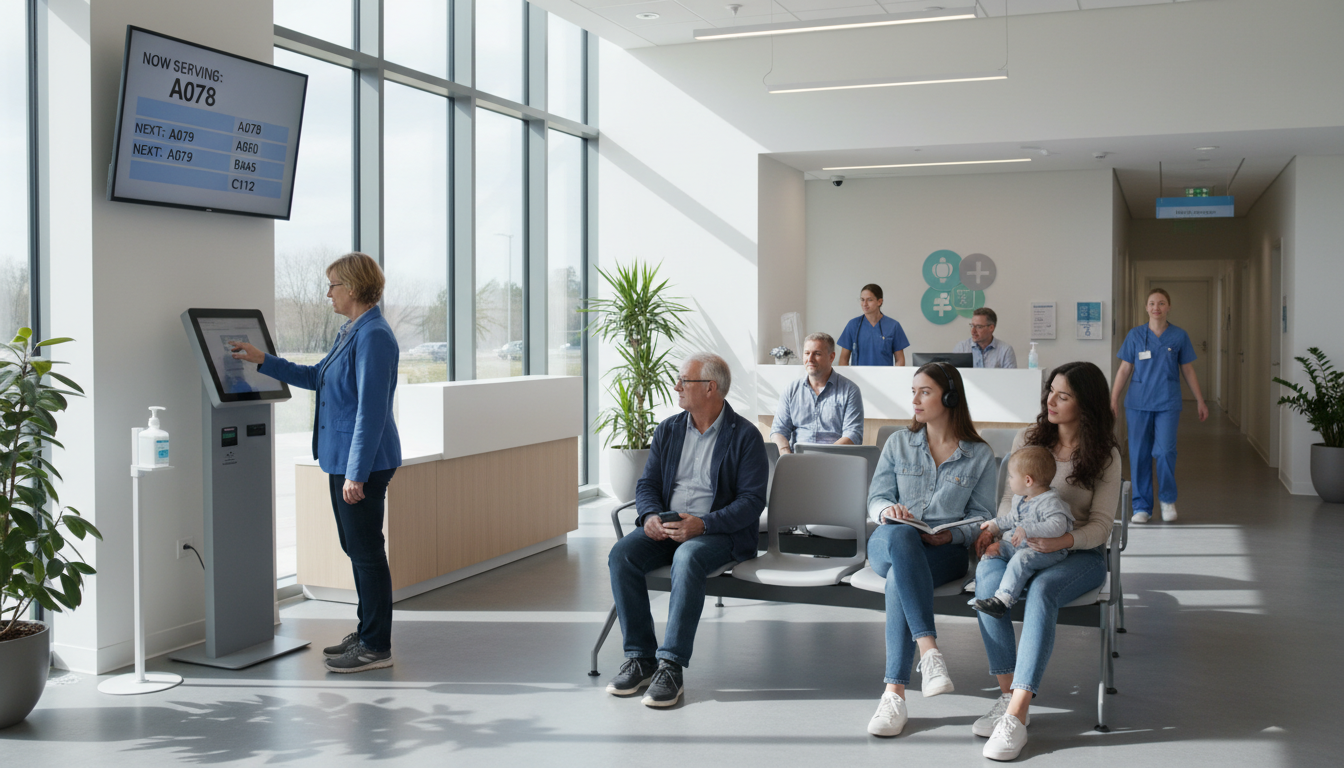
I’ve listed the key benefits of Queue management system below.
- Reduced waiting time – A dedicated queue management solution reduces patient wait time by 30-35%. Here is how.
- Smart Tokens – Through token prioritization, hospitals can issue tokens based on urgency or service types. Patients get smart tokens either through patient check-in kiosk, hospital apps, web portals, etc. This speed ups the queueing process.
- Queue status updates – real-time notifications regarding the patient queue status are sent via SMS, WhatsApp messages, or via digital display screens. Patients constantly remain updated of their status which they appreciate. This eliminates the element of uncertainty among patients and keeps them calm and engaged.
- Appointment scheduling – Most healthcare providers have both manual and automated appointment scheduling systems to manage patient visits. Patients can schedule their appointment in advance via multiple channels like hospital front desk, official website or mobile app, or via patient check-in kiosk machines. Appointment scheduling helps patient save time, and eliminates the ordeal of waiting for hours. Yes, you’ve been there!
- Streamlines patient flow – For big hospitals and other healthcare facilities, managing patient flow is an uphill task. There are plenty of departments, care centers, OP/IP patients etc. A queue management system directs the patients to the appropriate departments or counters, thereby reducing waiting time, confusions and bottlenecks.
- Improved staff allocation – A dedicated QMS helps to allocate staff to a department where the demand is higher, thereby improving staff allocation. This is possible by acquiring the real-time workload data at every patient touchpoint. The data-backed staff allocation immensely helps to reduce employee fatigue, which leads to major operational inefficiencies.
- Real time data – QMS helps to track customer interactions at each and every customer touchpoint. Right from the initial patient check-in, directing the patient to a specific counter, the time the patients wait, etc. can be tracked with great precision and accuracy.
The integrated analytics dashboard helps hospital management to track and analyse this crucial data with the help of reports, graphical representations etc.
For example: if the management finds an inefficiency and accompanied time delay in any of the departments or processes, they can rely on the analytics dashboard to track and analyse the reasons for the inefficiency, and take the corrective measures ASAP.
Data Analytics plays a huge role in patient retention too.
- Improved operational efficiency – QMS helps to improve hospital’s operational efficiency by reducing patient wait time, streamlining patient flow, prioritizing patient requests, reducing congestions, and through actionable insights. All these factors play a major role in improving the operational efficiency.
- Improved patient retention – Studies claim that retaining a patient is far more cost-effective than getting a new one. Hospitals around the world definitely know this.
It is estimated that around 40% of the existing patients avoid revisits due to patient experience-related issues.
Patient wait time is an important contributing factor to the overall patient experience. A queue management system makes the patient flow more transparent and structured. This helps patients to track their progress in the queuing process or know their real-time status during the waiting period.
We all have been in this situation several times, and therefore, it’s not difficult to relate!
- Improved patient care – Healthcare facilities achieve improved patient care by reducing patient wait times, streamlining customer flow, implementing systematic patient prioritization, and through enhanced communication. Allocating staff to specific departments based on real-time data helps to deal with peak hour demands.
Other Use-case scenarios in healthcare
Apart from the mainstream hospital settings, Queue management solutions can be implemented in these scenarios too.
- Clinics – Clinics with considerable number of patients can implement Queue management solution to streamline their day-to-day operations.
- Queue management solution for Health screening centers – The health screening centers play a major role in managing public health. They conduct medical screening tests in connection with employment, travel and residency. The Ministry of Health screening centers in UAE and Saudi Arabia handle a large number of visitors on a daily basis.
- Veterinary hospitals – Queue management solutions streamline pet and animal appointments, and enhances the service quality of these establishments.
- Lab test centers – Both government and private-owned labs and diagnostic centers can implement queue management to reduce waiting times, and manage congestion. The solution also reduces the burden on the employees.
- Pharmacy – Hospital pharmacies can be busy most of the time, particularly the OP pharmacy. Queue management puts patients at ease, reduce waiting, and streamlines pharmacy operations.
- Vaccination centers – Virtual queuing system when deployed in vaccination centers reduces waiting time and improves service efficiency.
Now, that’s a wrap
Increase in patient wait times can result in patients leaving without meeting the GP, or rescheduling the visit. In some cases, patients may rethink of a revisit, and may schedule an appointment elsewhere. This might result in loss of revenue for the healthcare provider.
Whether it’s leaving without consultation or rescheduling, the scenario results in delayed patient care – which is a big NO.
Delayed patient care may aggravate the medical condition, and in some cases can endanger the life of the patient too.
Comprehensive queue management systems take care of the patient flow, reduce wait times, and enhance the overall patient experience. With efficient patient flow management, hospitals can significantly increase patient throughput, which contributes to improved revenue generation.
And, it’s not only about patient care. These queue management solutions relieve hospital employees of their burden, thus, improving their productivity. As a result, you may engage employees in more productive or result-oriented roles like patient care, operations, public relations or marketing.
As I have already stated, a queue management solution is not a luxury. It is an indispensable tool for efficient hospital management.