
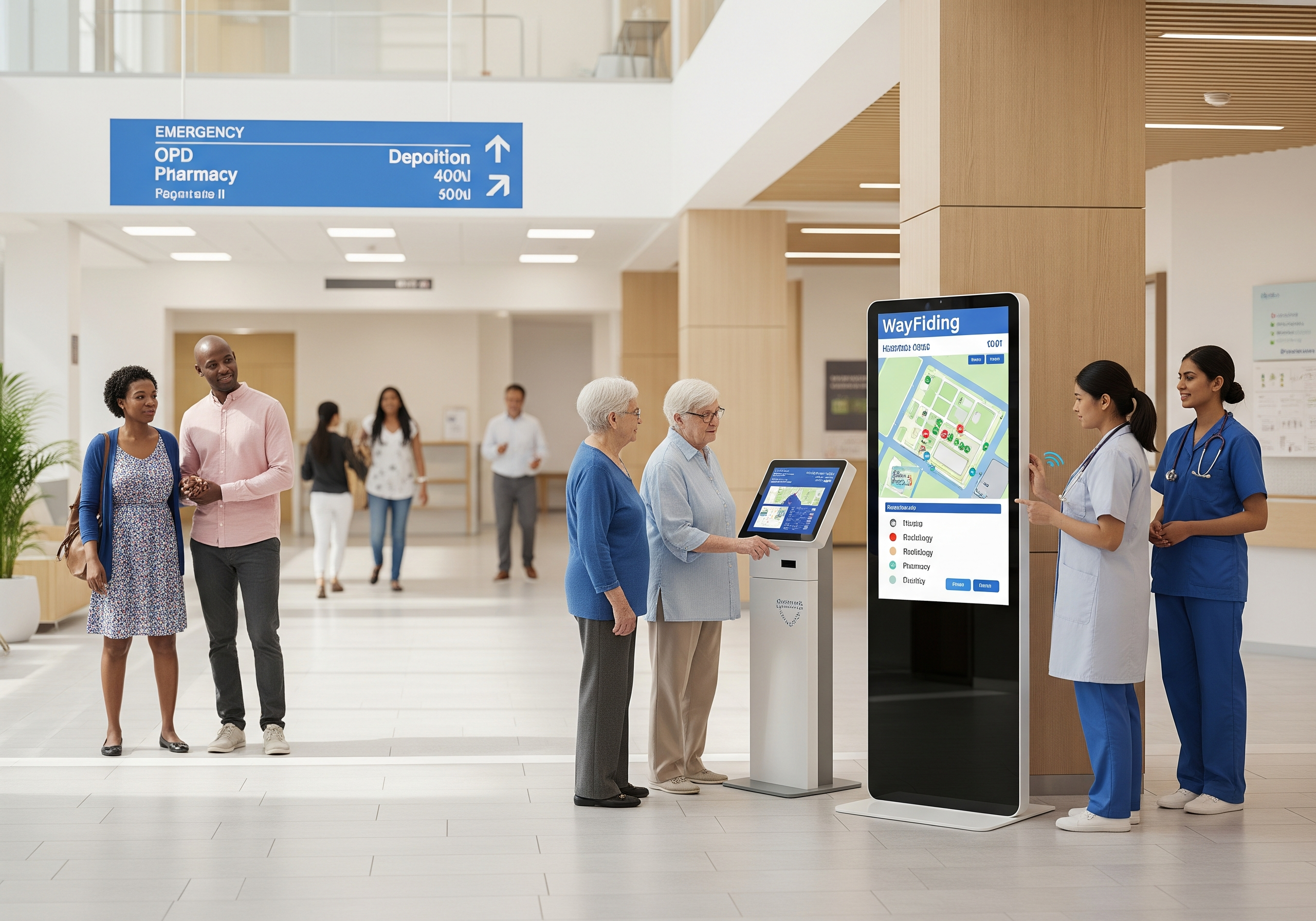
Hospital Wayfinding Solutions Explained: Why Every Hospital Needs One
Have you ever felt confused or lost while navigating a hospital complex?
If you are new to a large hospital complex, it’s kind of tricky to navigate the interiors. Quite often you end up asking for directions – of course, I can understand.
Research claims that 30% of the first-time visitors to hospitals feel utterly confused.
Letting your patients or their bystanders or even visitors stray around the premises without any navigational support or assistance is a big NO.
Lack of functional navigational tools and solutions in hospitals can cause stress, anxiety-issues among patients. And this results in arriving late, missing appointments, appointment rescheduling, appointment cancellation etc. All these issues can adversely affect patient satisfaction scores.
Here comes the relevance of Hospital Wayfinding solutions.
And, we are about to go through these wayfinding solutions and ther benefits in pretty detail, in layman’s terms.
Stay tuned…
What is a Hospital wayfinding system?
A hospital wayfinding solution comprises of certain tools, digital solutions, technologies that help patients, visitors and staff navigate large healthcare facilities and complexes avoiding confusions and waste of time. Healthcare facilities with multiple departments and testing centers require efficient ways of guiding patients to their desired destinations. Any inefficiency or confusions related to wayfinding can cause stress to the patients which should be avoided at any cost.
Drawbacks of conventional healthcare wayfinding systems
The conventional systems of wayfinding are often confusing for the visitors and the patients.
- Overcrowded signage – the hospital walls are usually over-crowded with both paper or static signages, and patients who are new to the hospital find it difficult to locate them.
- Less impact among the users – the conventional paper-based signages often fail to catch the attention of users, and often go unnoticed.
- Difficulties for physically challenged – most often, People of Determination cannot access or follow the instructions published on the conventional signage solutions due to reading or interpreting challenges.
- No real-time information – conventional signage solutions cannot provide real-time updates like appointment closures, waiting status updates etc. which keeps patients unaware of the real-time happenings.
- Language barriers – The traditional wayfinding solutions only display instructions in a single language, with no option to select the desired language. Most often, patients and their bystanders would have to depend on the hospital staff.
Commonly-used Hospital Wayfinding Solutions
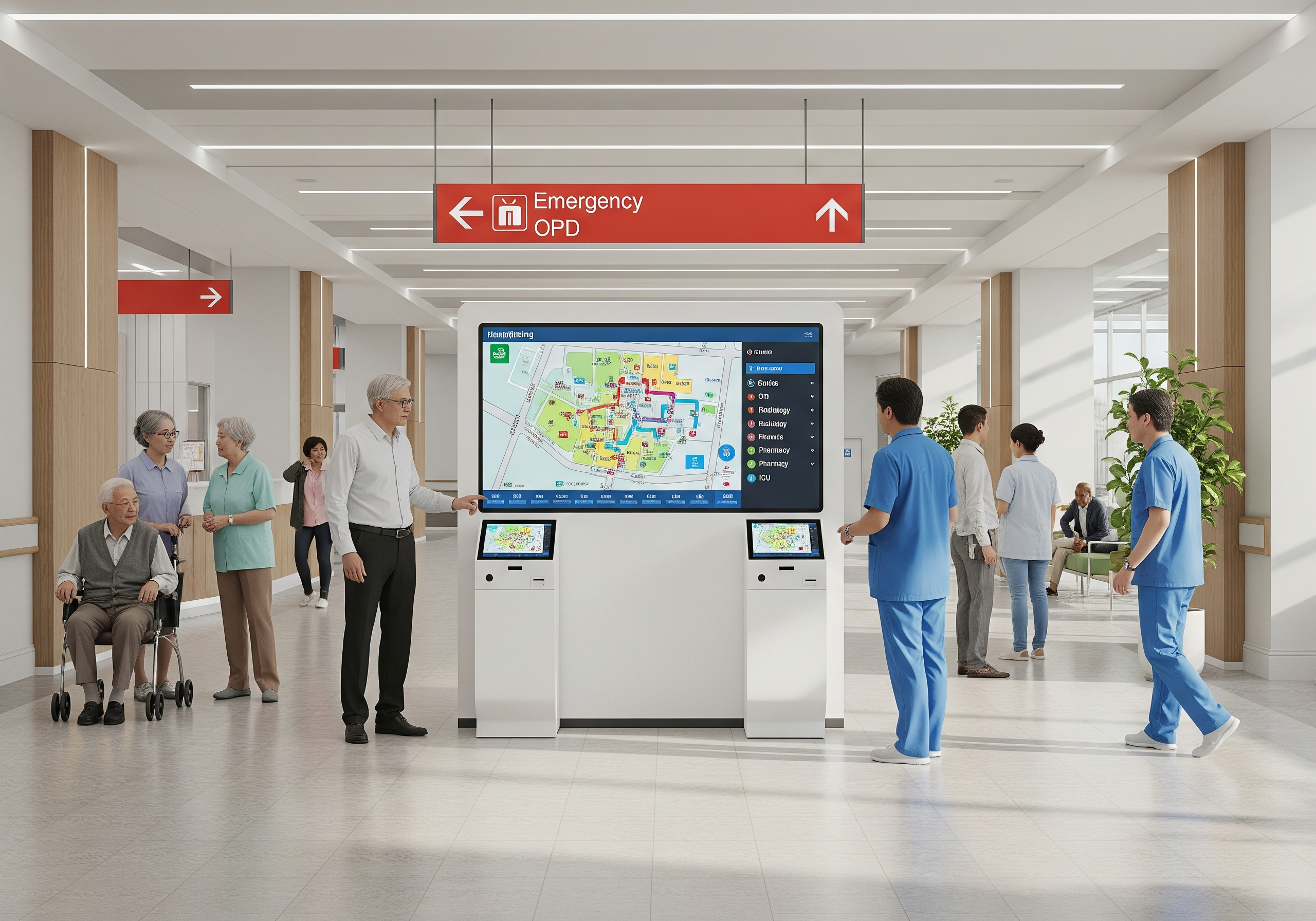
Wayfinding Kiosks for hospitals
Wayfinding kiosks are interactive touchscreen kiosks that offer hospital navigational assistance to patients and visitors. These machines are usually located at the main entrance, reception or other strategic areas for maximum visibility.
Features of Wayfinding Kiosk machines
- The navigation kiosk machines are equipped with all the necessary features to provide adequate navigational assistance to patients/visitors.
- Touchscreen interface – a highly intuitive touchscreen interface with multitouch functionality for zooming or enlarging the maps, corridors, etc.
- Multi-language facility – the patients can select their desired language from a list of languages for the purpose of kiosk navigation. The feature helps diverse patient populations, especially in the multi-cultured societies of the middle-east.
- Doctor and department search – patients can perform doctor search based on several categories like the name of the medical practitioner, department search, etc. including their availability.
- Interactive maps – the wayfinding kiosk machine for hospitals provide detailed 2D and BD floor maps, which includes precise location of pharmacy, restroom, elevators, dining area, emergency exits, etc. The kiosk machines also offer turn-by-turn visual navigation assistance.
- Smartphone integration via QR code – through QR code scanning, users can easily get the directions real-time on their smartphone.
- Accessibility-friendly features – Wayfinding kiosks are equipped with Accessibility features to accommodate the needs of People of determination. Screen magnification software, speech-to-text and text-to-speech feature, tactile keypads, adjustable font sizes are some of the common Accessibility features integrated into the wayfinding machines. Advanced wayfinding kiosk terminals are equipped with voice command facility to facilitate touchless navigation for the visually impaired.
- Display promotional content – During kiosk idle time, the wayfinding terminals display promotional content related to medical or diagnostic services.
- Data Analytics – Through data analytics, the hospital authorities can gather insightful data regarding patient preferences, most performed doctor searches, peak hour data etc. The data can be used to optimize the existing communication and patient experience strategies.
For wayfinding kiosk installation at hospitals and clinics, please visit our official website.
Digital signage for hospitals
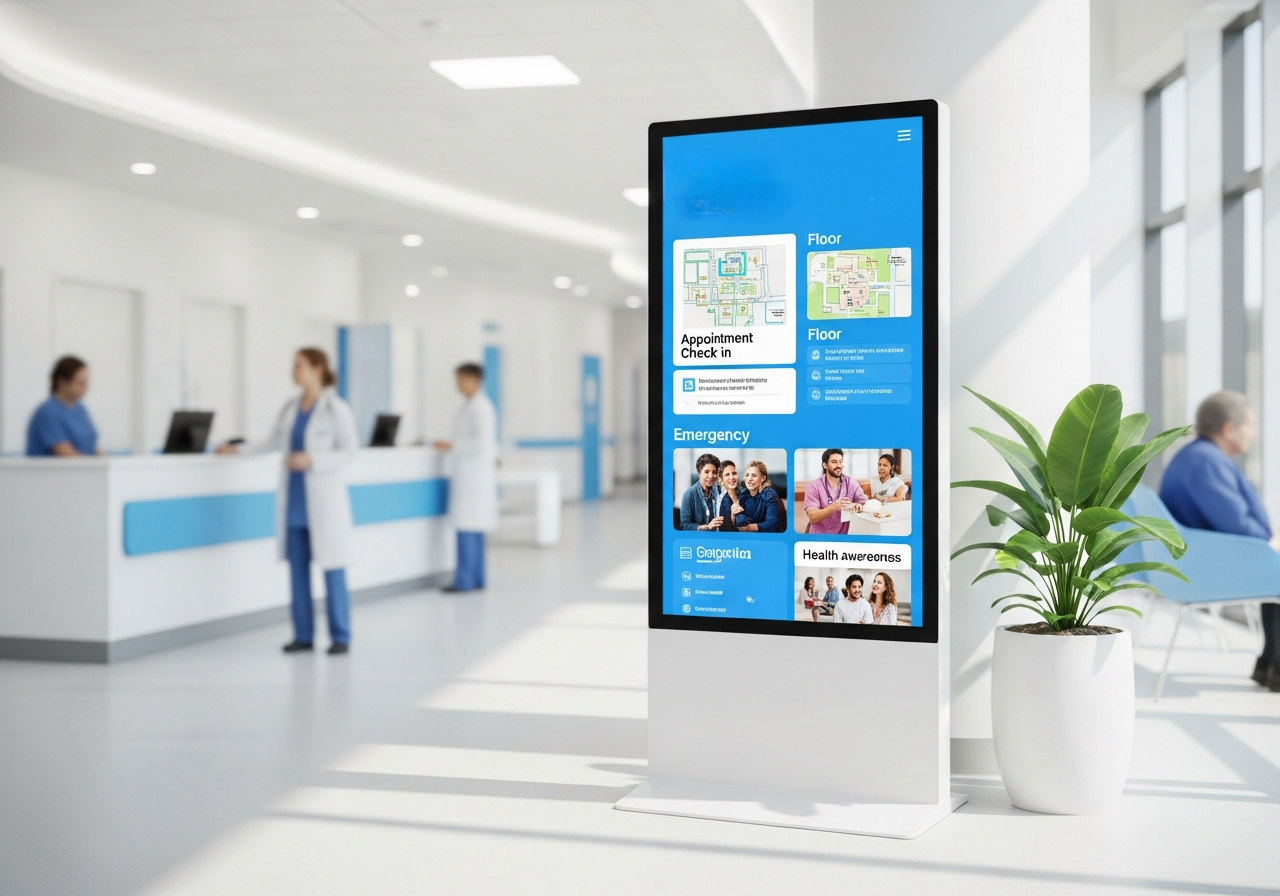
Hospital digital signage solutions serve as real-time information dissemination platforms that guide or inform patients about specific services or hospital amenities. These display solutions are strategically deployed at hospital receptions, corridors, waiting areas, in front of testing and diagnostic centers etc. They have an integral role in patient care as they offer clear directions, instructions, and messaging to the patients, directing them to respective departments.
How healthcare digital signage helps in a hospital environment?
Hospital display solutions play a major role in improving the overall operational efficiency of the hospital.
- Directional signage – those simple dynamic arrows indicating direction turns are highly effective in guiding patients and visitors to specific locations, blocks or departments. They have far more visibility than the conventional paper-based signage options.
- Queue management – Hospital display solutions can immensely help in queue management by sharing the existing appointment status, waiting time involved, etc. The information makes patients constantly updated and bring about transparency too. A functional and efficient queue management system with adequate digital signage support is indicative of high patient satisfaction scores.
- Information dissemination – Whatever be the information, medical or non-medical, the hospital authorities can clearly communicate the same with patients, by-standers, and visitors. Information clearly communicated – captures the attention of the audience, and results in patient engagement.
- Entertainment/Relaxation – patients have to wait for a considerable amount of time, especially in peak hours. Most hospitals engage LED screens in waiting area to display news or educational content.
- Display visitor information – These display solutions offer a wide range of information for visitors like reminders about hygiene, hospital rules and regulations, general instructions, etc.
For more on digital signage solutions, please visit our blog page here.
Mobile apps for hospital navigation
Once the patient has installed the hospital app in the mobile device, the app can be used to find directions to the desired locations like doctor cabins, pharmacy, patient rooms, testing or diagnostic centers, departments etc.
The step-by-step directions help patients and visitors navigate the complex interiors of hospitals with much ease, without interacting with any hospital staff.
Mappedin is a wayfinding solutions provider that offers highly intuitive and functional navigation solutions for healthcare and various other industries. Check out their website here.
3rd party providers create the maps, and their SDK is integrated into the mobile app, so that the users can easily access navigation services within the hospital app.
AR-assisted hospital navigation
AR-assisted navigation is assumed to be the next big thing in hospital navigation.
By simply scanning a QR code with a mobile device, you may active an AR route to your preferred destination, be it hospital pharmacy, or any specific department. On-screen step-by-step directions and hospital destinations are overlaid to the real-world view to produce a more detailed-oriented information of the hospital premises. The digital information includes the distance ahead to reach the specific destination, reception info, doctor cabin info etc. which makes navigating the hospital premises a lot easier.
It is estimated that the AR-assisted hospital navigation is twice faster than the physical signage-assisted, conventional means of hospital navigation.
According to the research conducted by Statista, the market size of Augmented Reality in healthcare, as of 2022, was valued at 1.6 billion US dollars. The value is projected to reach 12.23 billion US dollars, by 2031, achieving commendable growth in a span of 10 years.
Benefits of Hospital Wayfinding Solutions
And, the benefits are here.
Faster navigation – patients are able to navigate the hospital complex much easier without relying on the staff. It also reduces the instances of unwanted personal interactions with other patients or visitors for the sake of navigation. Patients/ visitors reach their destinations on time which eliminates delays, appointment cancellations, etc.
For healthcare providers, missed appointments cost billions of dollars annually. For US healthcare system, this amounts to a whopping 150 billion US dollars, a year.
Reduced burden on hospital employees – You won’t find hospital staff getting distracted by helping patients and visitors with directions. With hospital wayfinding solutions, the staff can fully focus on their routine work which improves the overall staff productivity.
Reduces patient anxiety and stress – In this case, patients feel highly empowered and confident that they can reach their destinations without any confusions or delays. This significantly reduces anxiety, and as a result enhances their mood.
Improved patient satisfaction score – Improved patient care becomes possible through improved patient experiences. Reduced delays and confusions, feeling of empowerment, reliable and accurate navigation support, successful appointments – all these factors significantly improve the patient satisfaction score.
Increased patient throughput – efficient patient navigation helps patients accomplish their tasks in minimum time. Patient-processing takes place smoothly in a timely manner which increases the patient throughput.
Scalability – The hospital navigation solutions are perfectly scalable. If the hospital authorities are planning to expand or set up a new block in the premises, these solutions can perfectly cater to those future expansion requirements.
Remain competitive – The technology integration in hospital navigation positively impacts not just the patients. It helps the staff, patient bystanders, and visitors too. The positive patient experience receives so much of word-of-mouth recognition and visibility. This helps hospitals in a great way to remain competitive and innovative in the dynamic, technology-centric healthcare domain.
Patient/visitor data acquisition – the hospital authorities can gather authentic customer data based on their interactions, preferences, and other key navigational needs. The data gives hospital authorities several key insights on the day-to-day management aspects, departmental needs, service efficiency etc.
Conclusion
Allowing patients and visitors easily navigate complex hospitals layout is a basic necessity. Hospital wayfinding solutions like wayfinding kiosks, mobile app, digital signage, AR-assisted navigation solutions – have a significant role in improving the overall patient experience.
By implementing these solutions for wayfinding and navigation in hospitals, the authorities can focus more on patient care while empowering patients/visitors with self-guided, rewarding hospital experiences.
Healthcare establishments – around the globe – are on the path of embracing technology integration into wayfinding and navigation. Yes, it’s a global trend, and you are not supposed to lag behind.
For any support or recommendations regarding hospital navigation, please get in touch with our experts.