
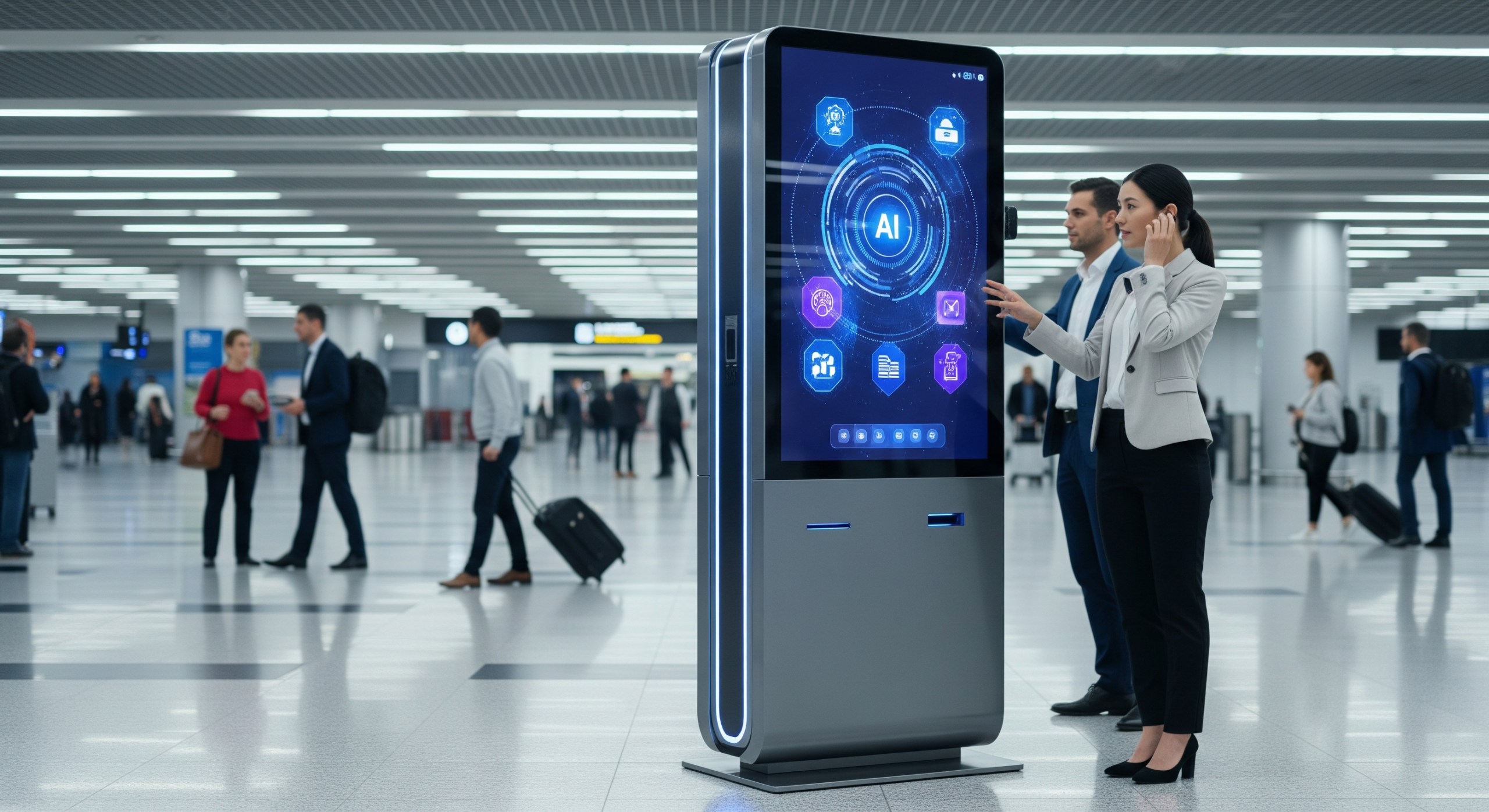
How AI Enhances the Functionality of Information Kiosks?
Have you ever thought of how AI enhances the functionality of Information Kiosks?
Have you deployed these automated Information dissemination platforms in any of your customer service centres?
You might have seen manually-managed Information centres at transportation hubs like railway stations, metro stations, bus stations etc. Even government agencies and departments have dedicated information centres to provide relevant answers to service-related queries.
At peak hours, the public/customers have to wait several minutes, in front of the Information counter, to clear their queries. This waiting time and congestion at counters significantly affect the overall Customer Experience.
Information Kiosks are excellent alternatives to address this age-old issue. These self-service kiosk terminals automate the task of information dissemination with excellent efficiency, avoiding manual intervention.
With the advancement of AI, the scope and benefits of Information kiosks have further enhanced. In this blog, we’ll look into the role played by AI in these amazing machines. You can also have a clear understanding of the industries that make use of these kiosks.
What is an Information Kiosk?
An Information Kiosk is a self-service terminal that serves as a 24/7, automated information access platform for organisations and service providers. The users may access information or services via Information kiosk machines without any interaction with human agents or employees.
Information Kiosks display both static and dynamic contents depending on the purpose of deployment. Static contents are used for general purpose requirements like displaying directions or specific instructions etc. Dynamic contents ensure more personalisation and interactivity; hence they are more task-based.
Most Information kiosk terminals are equipped with a touchscreen user interface. And these interfaces facilitate highly convenient information access with few taps on the kiosk screen.
You can easily spot an Information Kiosk at transportation hubs, event venues, parks, hospital settings, government departments, and even at public locations.
How AI enhances the functionality of Information Kiosks?
- Personalised suggestions – AI kiosks can identify user profiles, and offer personalised suggestion or recommendations based on their previous interactions, queries, language preferences, service requests etc. The Information kiosk terminal identifies the user through facial recognition or via user credentials, and come up with offers or suggestions that align with user preferences.
For example: if a patient visits a hospital, the AI-powered Information Kiosk would interact with the person in a human-like manner. The kiosk machine would inform/remind the person about his latest doctor bookings or appointments. Suppose the patient misses an appointment for some reason, the kiosk would instantly come up with the next booking date, provided the kiosk system is integrated with the hospital booking system. Therefore, the patient remains well-informed about the latest appointments.
Kiosk machines can also provide valuable information regarding doctors, departments, Health insurance providers, room availability etc. to the patients.
A well-informed, updated patient is more probable to show up on the booking date, thereby increasing the chances of revenue generation.
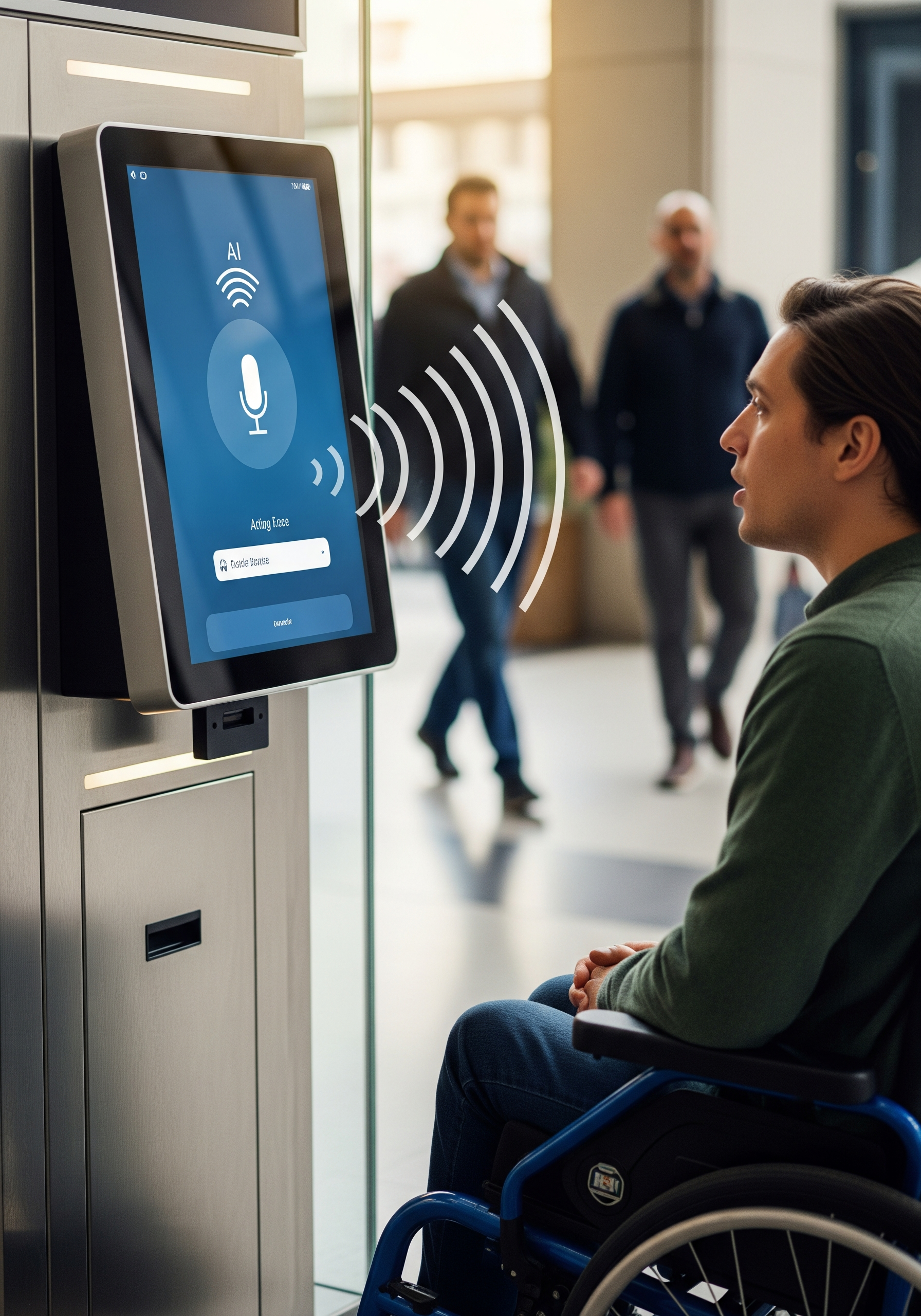
- AI-powered voice-assisted interactions – You don’t need to tap on the kiosk touchscreen while you interact with an AI-powered information kiosk terminal. You may engage in a natural conversation with the kiosk machine, just like you interact with a human agent.
The voice-assist capability allows contactless interactions, which improves hygiene, to a good extent.
Moreover, the voice-enabled kiosk interactions work in favour of Accessibility. Even wheelchair users can easily interact with a voice-enabled kiosk machine.
For example: a passenger can access a voice AI Information Kiosk, and simply ask the direction to any of the facilities, like “Where is the Airport lounge?” Cool, isn’t it?
- Multi-lingual support and real-time translation – AI-enabled kiosk machines are highly beneficial in multicultural societies like the UAE and other middle-east countries, UK, India where people speak multiple languages.
The users may interact with their desired language. With real-time translation capability, the kiosk detects the user language from speech input, and offers a conversational reply in the same language. The multilingual support capability is highly useful in multiple domains like Airports, hotels, tourist destinations, and other high foot-fall areas.
- Predictive Analytics for improved service delivery – You know, AI is an excellent learner! It learns from every customer interaction, collects and analyses usage data. Through data analysis, the kiosk system gathers information regarding the peak usage time, frequently asked queries, and user behavior.
The gathered, data-backed information is crucial, as it helps service providers tweak their services, improve their information dissemination priorities etc.
How are Information Kiosks used across different domains?
The self-service Information terminals are widely used across several industries. I’ve listed some of the important ones below.
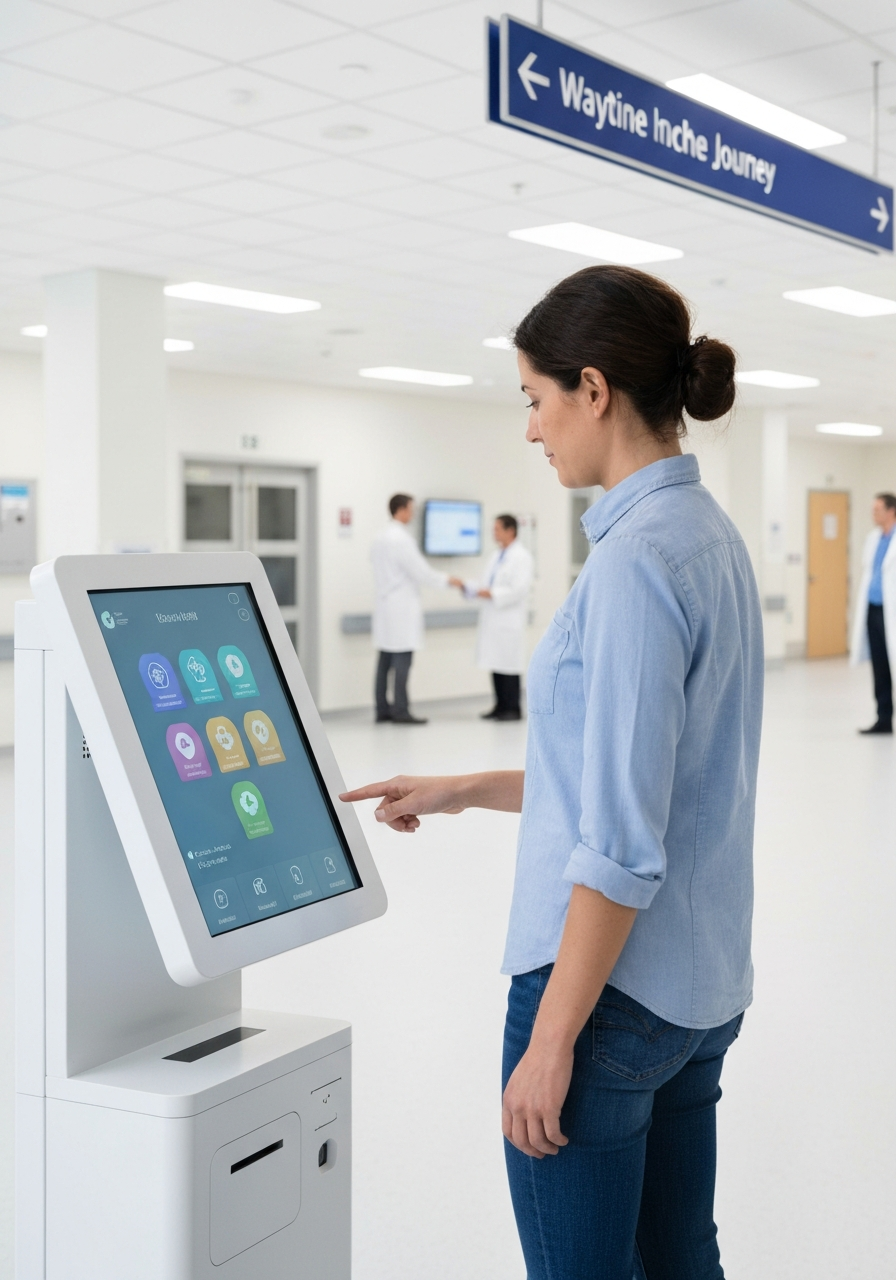
Information Kiosk for Hospitals and other healthcare facilities
The opportunity to access relevant, authentic health information helps patients take well-informed decisions, claims CISM – a Mozambique-based health research center.
Information Kiosk terminals are highly useful in hospital and clinical environments. They do a great job in improving the overall patient experience.
- Directions and wayfinding – display directions and locations of various hospital facilities like departments, wards, labs, pharmacy etc.
- Doctor info – Display information related to doctor availability, directory, consultation timings etc.
- Queue info – show updated wait times, queue status, other patient-relevant information.
- Access medical examination results – the patients can easily access medical examination results via the kiosk without having to wait at the hospital reception.
- Healthcare awareness content – showcase videos, animations, posters related to health awareness, disease prevention tips etc.
- Promotional content – publish advertisement or promotional content related to medical examinations or any specific medical equipment or procedure.
Patient feedback – serves as an efficient patient feedback portal. Patients can input their feedbacks by simply entering their Hospital IDs.
Information Kiosk for Public spaces (forgovernments)
According to UNESCO, Access to Information is “the right to seek, receive and impart information held by public bodies”.
It’s the right of every citizen to seek and receive legitimate, relevant information. And, it’s an important aspect of the fundamental rights.
Every year, 28th of September is regarded as the International Day of Universal Access to Information.
Government agencies, departments and Ministries can publish their policies and services via the interactive Kiosk terminal.
- Government service access portal – serves as a 24/7 platform that offers a plethora of government services and schemes.
- Maps, directions, amenities – display city maps, directions, information regarding local attractions, amenities, transportation facilities, cab services, parking lots, etc.
- e-governance platform – serves as an e-governance platform that allows users to file e-applications, pay bills etc.
- Grievance support platform – the public can submit their feedbacks or file complaints regarding services.
- Share updates and announcements – functions as a government news portal, offers weather updates, traffic updates, emergency updates etc.
Information kiosk for transportation hubs
Information kiosks can serve the transportation industry as well. Here are some of the ways by which transportation hubs like bus depots, railway stations, metro stations can benefit the Information disbursal portal.
- Display fare, routes, and connectivity information – The Digital Information booth can inform and educate visitors, tourists about various travel options, service availability etc. which includes the fares.
- Travel time – Display arrival and departure times, offer updates regarding schedule change, etc.
- Ticket booking and payment facility – facilitates ticket booking and payment facility for visitors via the kiosk machine.
- Travel and sightseeing information – offer information regarding city tours and packages, sightseeing options, 3rt party travel advertisements. The visitors can browse through various offerings, and perform the bookings instantly via the kiosk machine.
- Travel-related advisory – Effectively communicate travel-related instructions and advisory with tourists.
- Visitor or commuter feedback – Collect commuter or visitor feedback and use it for future service enhancements.
Information Kiosk for Airports
Airport terminals can deploy Information kiosk terminals to enhance the overall passenger experience.
- Share vital information – the Information Display Terminal displays relevant, updated information regarding flight timings, gate numbers etc.
- Baggage claim assistance – offers baggage claim assistance to passengers.
- Wayfinding assistance for airports – display detailed maps of airport terminal and helps passengers with airport wayfinding. The kiosk terminal offers information related to airport lounges, restaurants, and other airport amenities.
- Display promotional items – present information related to hotel-booking, accommodations or local transportation availability near the airport or other 3rd party content.
- Video chat assistance – If needed, the passengers can interact with a remote Airport staff for service-related assistance.
Information Kiosk for Entertainment venues, events
Self-service terminals can engage or inform visitors in an entertainment or event setting.
- Event-related info – Display event-related information like schedules, program itinerary, details of performer, maps and directions, etc.
- Advertisement and promotion – The self-service information terminals can display promotional content related to the event, or organizers, products or merchandize, sponsor information etc.
- Seat occupancy info – Display real-time information regarding seat occupancy, offers and discounts, etc.
Social media integration – Facebook/Instagram or YouTube integrations help people post real-time photos and videos, selfies on their preferred social platform
Information kiosk for cultural and religious institutions
Even cultural and religious institutions can leverage the benefits of Information Kiosk machines. Here is how.
- Charity/fundraising Info – serve as fundraising platforms by displaying campaign-related content and attracting user engagement, leading to meaningful donations.
- Provide multilingual content for international visitors – Panashi Information kiosk machines are equipped with multilanguage facility. The visitors can select their preferred language to easily understand the content and context of the information shared.
- Ceremony/ Program itinerary/ exhibits – Display information related to programs, ceremony schedule, exhibit info etc. so that that visitors remain engaged and informed.
- Storytelling platform – Kiosk machines serve as effective storytelling platforms, especially in the case of museums, art galleries etc.
Information Kiosk for Hotels and Resorts
The hospitality industry can educate, engage and inform their customers by deploying Information kiosks at strategic locations.
- Wayfinding solution – An information kiosk can display detailed maps, directions and amenities in hotels, thereby ensuring visitor guidance.
- Local attractions and sightseeing – can provide details regarding local tourist attractions and destinations.
- Tour booking – Tourists can even book cab service or other transportation service via the kiosk machine with a few taps on the kiosk screen. Hotels and resorts may partner with local tour agents and organise local sightseeing journeys, with the kiosk as the tour-booking touchpoint.
- Promotional content – Hotels can effectively display hotel amenities like restaurant, prayer room, gym etc. in video format via the kiosk machine.
- Loyalty programs – Run guest loyalty programs to encourage repeat visits and stays, thereby generate revenue.
- Capture guest feedback – Hoteliers and resorts can collect valuable guest feedbacks via Information kiosks. Feedbacks help to improve their existing services, accommodation facilities, and help in improved decision-making.
Conclusion
A user approaches an Information Kiosk terminal to access information about the services offered or perform certain tasks. Customers expect relevant, updated information in minimum time. Therefore, frictionless information dissemination is always the key to win the hearts of your customers.
If your customers can access legitimate information, 24/7, without having to stand in long lines, they would certainly appreciate your service. AI enhances the functionality of Information Kiosks by improving the speed of user interactions, allowing personalisation, and enhancing the overall service delivery.
When it comes to Information Kiosk price, the price usually starts from 1000 US dollars and can increase depending on the technology and hardware integrations. For pricing-related information, please get in touch with Panashi technical team.
Lorem ipsum dolor sit amet, consectetur adipiscing elit. Ut elit tellus, luctus nec ullamcorper mattis, pulvinar dapibus leo.